You have enough cleaning work to add a person, but not enough spare time to redo every room behind them. Requiring years of experience feels safer. Hiring someone new feels cheaper. Neither tells you whether you can actually support the hire.
You can hire cleaning employees without prior professional experience if the opening is genuinely entry-level and you can provide the instruction, supervision, equipment, and time the work requires. The first decision is about your capacity to train—not which adjective to put in the job ad.
This guide focuses on a small U.S. business hiring employees for routine commercial or residential cleaning. It does not cover specialist remediation, hazardous-material cleanup, or the separate decision about employee versus contractor classification.
Choose the opening you can support
The Bureau of Labor Statistics says most janitors and building cleaners learn on the job, often alongside an experienced worker. That supports considering beginners for appropriate openings. It doesn’t mean all cleaning assignments are interchangeable or that a new employee can safely start alone.
Compare these two situations:
- A supervised team opening: an experienced employee can teach a defined set of tasks, review the result, and remain available for questions. A beginner may fit.
- An immediate solo assignment: the worker needs to handle access, equipment, client communication, and unexpected problems independently from the start. Prior relevant experience may be necessary—or the job needs redesigning.
Write down who will train the person and which customer assignments can accommodate that training. If the answer is “whoever has a moment,” postpone the promise of a fully supported beginner role.
Describe the route, not an imaginary ideal employee
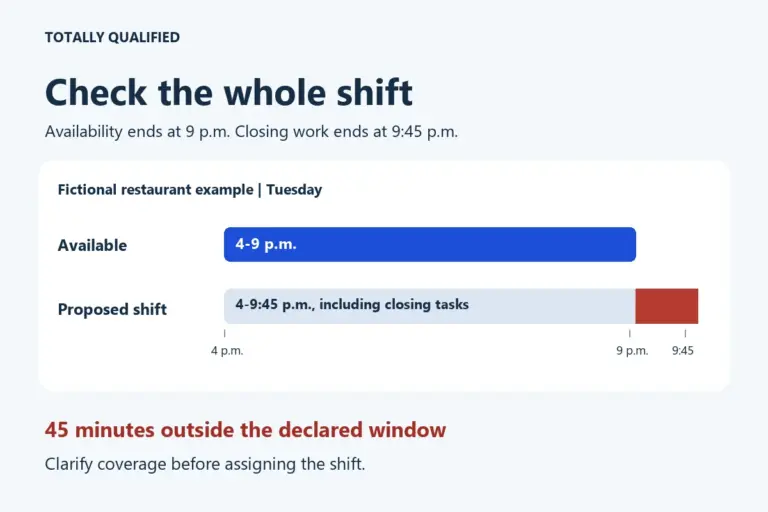
Before recruiting, prepare a short job brief with the actual work area, typical shift window, expected hours, reporting arrangement, pay or genuine range, and whether the employee starts at one site or moves between sites. Explain whether work is solo or in a team and who provides transportation between assignments when relevant.
Separate arriving at a fixed workplace from driving as part of the job. Don’t require a personal car simply because the previous employee owned one; establish what the duties actually require. If driving is essential, explain the requirement and review the relevant qualification and insurance arrangements.
Travel can also affect pay. For employees covered by the FLSA, the Department of Labor distinguishes ordinary commuting from travel between job sites during the workday; the latter counts as working time. Check applicable state and local rules and explain your timekeeping process before assigning a route.
List a few real tasks and what training covers. Replace “must be a perfectionist” with something observable, such as checking assigned areas against a checklist and reporting a problem that prevents completion. Avoid promising predictable hours if customer demand will regularly change them.
When you turn that brief into an advertisement, use our residential and commercial cleaning job posting templates to make the schedule, travel arrangement, and training clear before applicants respond.
Recruit where you can explain the actual job
Start with channels you can manage consistently: a clear public job posting, appropriate local community job boards, and your local workforce office. CareerOneStop’s Business Center provides recruiting resources and a route to local American Job Centers. Ask what employer services are available locally; don’t assume every office offers the same screening or training support.
Employee referrals can supplement that search, but give referred applicants the same job information and assessment process as everyone else. Familiarity with a current worker is not evidence that someone can handle keys, follow product instructions, or work the advertised shift.
Keep the first response simple: relevant experience, availability for the actual shift, and a way to arrange a conversation. A first-time applicant may be able to describe useful work from another job or organized activity. Don’t collect bank details or identity documents in a public job-ad reply.
Assess judgment before expecting your cleaning method
A beginner won’t know your products, sequence, or client rules until you explain them. During the interview, use a few ordinary situations to learn how the person approaches uncertainty. These are discussion prompts, not a validated hiring test:
“You arrive and can’t access the building. What would you do?” Look for using the agreed contact process and waiting for authorized instructions, rather than borrowing someone else’s access or improvising entry.
“A client asks for a task that isn’t on your assignment. How would you handle it?” A useful answer includes clarifying the request and checking with the supervisor before making promises. Don’t expect the applicant to know an unwritten contract.
“You notice damage before starting. What happens next?” Discuss reporting it through the company’s process before proceeding. If documentation is needed, teach an approved method that protects client privacy; casual photos on personal phones shouldn’t be the default.
“Tell me about a time you were shown a task and needed something explained again.” Listen for what the person asked and how they used the explanation. Being willing to ask is useful evidence; claiming never to need help is not.
Keep questions job-related. The EEOC explains limits on pre-offer disability questions. Describe the actual tasks without asking about diagnoses or medical history. Federal ADA employment coverage generally begins at 15 employees, while state or local protections may reach smaller employers. These prompts are not a complete compliance review.
If references would clarify a relevant point, use reference questions focused on observed work. A school or volunteer reference may discuss following instructions, but cannot verify professional cleaning experience the applicant never claimed.
Make training concrete before sending someone alone
For a beginner, plan paid, supervised employee training after hiring rather than asking for a free customer clean as an “audition.” Budget for instruction and review instead of assuming every scheduled hour immediately becomes independent production.
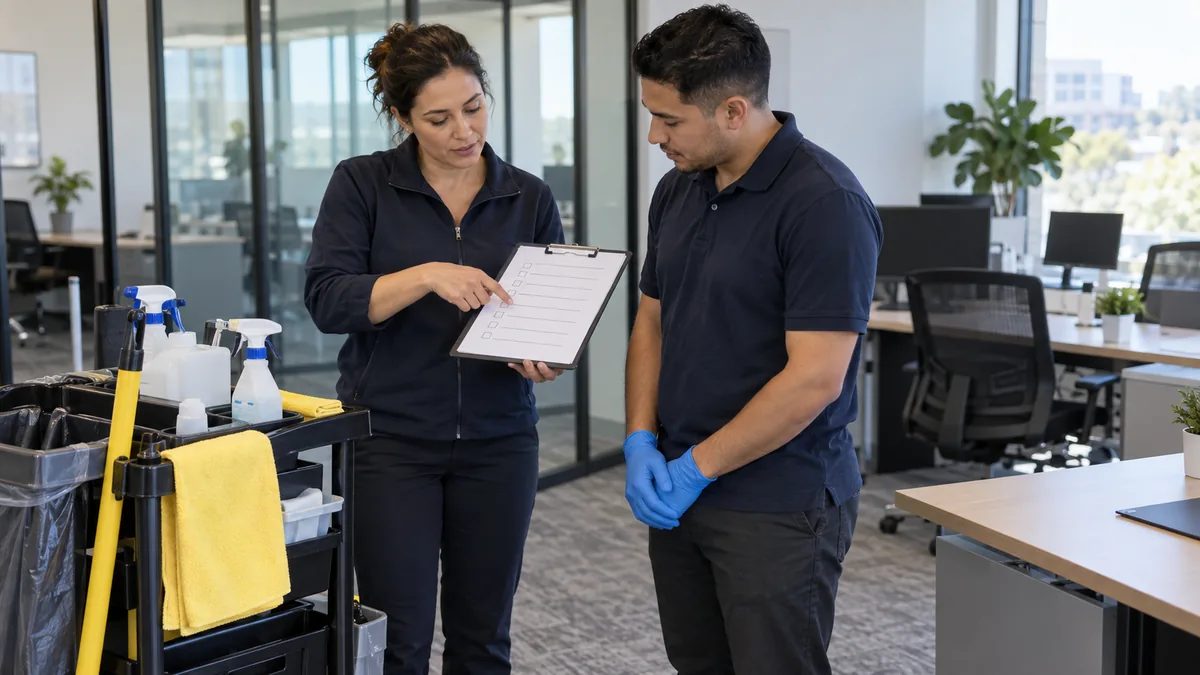
Prepare a short training record for the actual assignment:
- The tasks demonstrated and the standard used to check the result.
- The products and equipment the employee has been taught to use.
- The access, privacy, incident-reporting, and end-of-shift procedures explained.
- What the employee practiced successfully and what still requires supervision.
- The next review and the supervisor responsible for it.
Chemical safety is not something to learn by guessing. OSHA and NIOSH’s cleaning-chemical guidance explains that workers using hazardous cleaning chemicals need training before use, including hazards, labels, safety data sheets, protective equipment, and safe handling. Instruction must be understandable to the worker. Use the specific product information and applicable requirements for your workplace; this article is not a chemical-handling manual.
Don’t equate a signed training sheet with independent readiness. Watch the person carry out the taught work safely, review the result together, and decide which responsibilities can be assigned without direct supervision. A commercial cleaner and an apartment maintenance technician also have different scopes; our porter-versus-maintenance guide helps explain why repair duties should not quietly become part of a cleaning opening.
Use the first assignments to test your plan, too
If an area was missed, ask whether the standard was explained, the supplies were available, and the scheduled time was realistic before labeling the person careless. Give a specific correction and check the same task again. That is more useful than “work faster and be more thorough.”
If you truly need an experienced solo cleaner, say so and hire for that responsibility. If you can teach an entry-level employee, make that opportunity credible: a named trainer, a defined assignment, and a clear path toward working independently.