Your new server arrives at 3 p.m. The supervisor who agreed to train them is covering a callout, nobody has set up their clock-in, and someone says, “Just follow whoever looks busy.” That’s a staffing problem passed to a person who doesn’t know the building yet.
A restaurant first-day checklist should give the manager a workable plan for that shift: who owns the training, what the employee can safely practice, and what still needs attention tomorrow. It shouldn’t pretend one orientation makes someone ready for every station.
The outline below is for U.S. restaurant owners and shift managers onboarding a newly hired hourly employee. The training sequence is an editorial planning tool, not a food-safety certification or a complete employment-compliance checklist.
Before the employee arrives: protect the training time
Choose one trainer and a backup. Reduce the trainer’s regular assignment enough to make instruction possible. A strong server carrying a full section may be excellent at the job and still have no time to explain it.
Write down the first shift’s limited goal. For a host, that might be greeting arrivals, finding reservations, and getting a manager when the waitlist needs a decision. For a counter employee, it might be entering a straightforward practice order and knowing which questions to escalate. “Learn the restaurant” is too broad to check.
Confirm the arrival time, entrance, supervisor’s name, clothing or footwear instructions, expected finish, and how the worker should contact you if something changes. Clarify which items the restaurant supplies. Keep the schedule and duties consistent with the offer; our restaurant job posting template is useful for catching promises that never made it into the training plan.
Have timekeeping and payroll arrangements ready. For covered, nonexempt employees, required job-related training is generally paid working time. The Department of Labor’s hours-worked guidance explains the narrow conditions for excluding training time. Calling a required orientation “shadowing” doesn’t make it unpaid. Check state and local requirements too.
A first-shift checklist the manager can actually use
Assign an owner to each item. Mark it complete when the relevant step has happened—not merely because someone handed over a handbook.
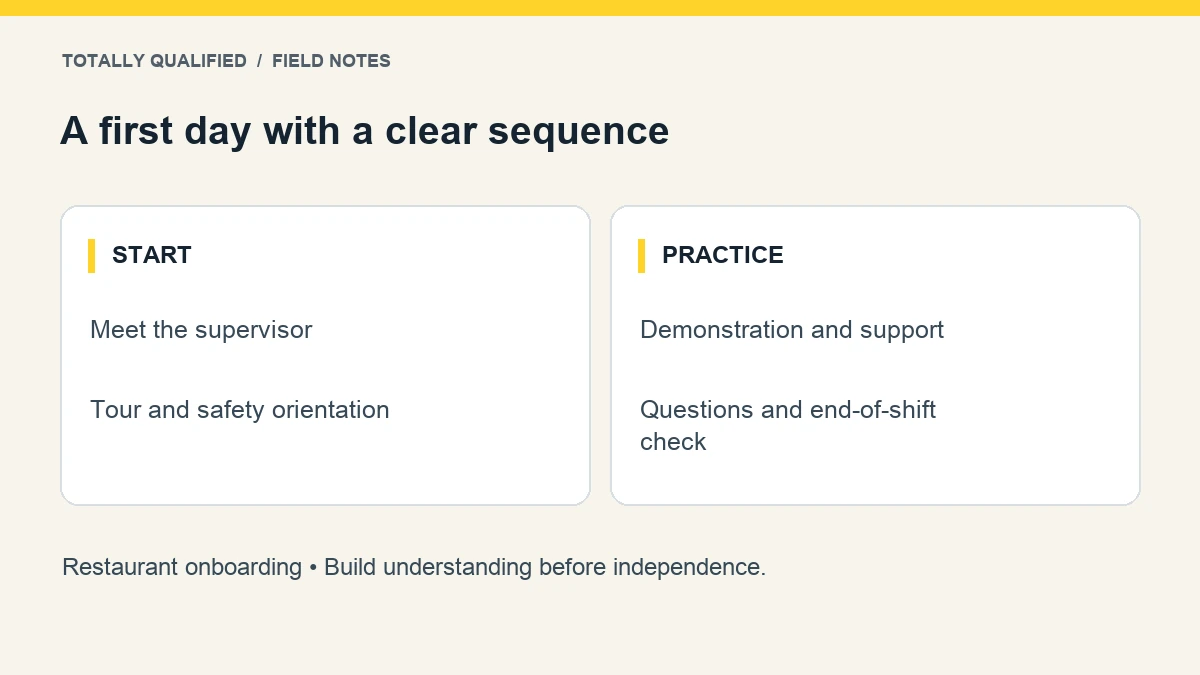
- Welcome and timekeeping. Introduce the manager and trainer. Show how to record time and report a missed punch. Explain how breaks will be arranged under the restaurant’s applicable rules.
- Essential locations. Show exits, the meeting point for emergencies, restrooms, the handwashing location, staff storage, and where to find the person in charge. Explain how to report an injury or immediate hazard.
- Limits for today. Name the assigned station, who supervises it, and which tasks or equipment the employee is not yet cleared to use. Don’t rely on “common sense” around unfamiliar equipment.
- Food-safety and illness-reporting procedures. Cover the procedures relevant to the assignment before food handling begins. Explain whom to notify about symptoms or other reportable health information under the restaurant’s food-safety procedures. Teach the route for allergy questions; nobody should guess an ingredient answer.
- Demonstration and supervised practice. Show one task, explain what to check, let the employee try it, and give specific feedback. Use a training mode or controlled example where available.
- Mid-shift check. Ask what remains unclear and whether the employee knows whom to ask for help. Adjust the assignment if service has made proper supervision impossible.
- Close the shift. Review what was practiced, record unfinished training, confirm the next shift and trainer, and check that all working time was recorded.
This order is a planning aid. A kitchen assignment may need substantial task-specific instruction before practice starts; a dining-room orientation doesn’t authorize someone to operate a slicer or fryer.
Show one task all the way through
Consider this hypothetical counter-service exercise. The trainer enters a simple practice order, pauses at each confirmation, and explains how to correct an error. The employee then repeats the task with supervision. Finally, the trainer introduces an unfamiliar modifier and asks whom the employee would consult.
That last step matters. Someone who knows how to stop and ask is better prepared than someone who can reproduce a memorized sequence but invents an answer when it changes.
Record the result narrowly: “Entered a basic practice order with one prompt; needs another supervised attempt.” Avoid “POS trained” after one demonstration. Keep customer information and live payment details out of practice materials.
If you identified a trainable gap during the restaurant interview, put it into this plan. Don’t treat it as a surprise performance failure after hiring someone on the understanding that you would teach them.
Keep paperwork deadlines separate from the training checklist
Use a secure onboarding process for identity and payroll documents. Don’t ask a new employee to send sensitive documents to a shared restaurant group chat.
For hires subject to Form I-9, the USCIS instructions require employees to complete Section 1 no later than their first day of employment, after accepting the offer. The employer generally completes Section 2 within three business days after the first day; for employment lasting fewer than three business days, Section 2 is due on the first day. Employees choose which acceptable documents to present. Follow the official instructions for document review and special situations.
Food-handler training, manager certification, illness reporting, and other food-safety requirements depend on the rules adopted where you operate. The FDA Food Code is a model used by regulators, not a single restaurant rulebook automatically in force everywhere. Confirm the requirements with your state or local food authority.
Also review age-specific restrictions if you hire minors. OSHA’s restaurant safety resources can help identify hazards for training, but they don’t replace applicable youth-employment rules or equipment-specific requirements.
What if the restaurant gets slammed?
Use the backup trainer or move the new hire to a previously explained, supervised task. If neither is possible, change the training plan. Don’t silently count a hectic shift of guessing as completed instruction.
Make the handoff concrete: “We covered greeting and reservation lookup. We have not practiced wait-time estimates. Please handle those decisions yourself until the next training session.” That gives the next supervisor something to act on.
Before the employee leaves, ask two questions: “What would you like to practice again?” and “Is there anything about the next shift that we haven’t explained?” Then write down the next training step and who will own it. A useful first day ends with a clear next assignment, even when the original plan had to change.