A manager spends half an hour interviewing a strong applicant, then learns the person can’t work the closing shift the store actually needs. A short phone screen could have surfaced that mismatch before either person rearranged their day.
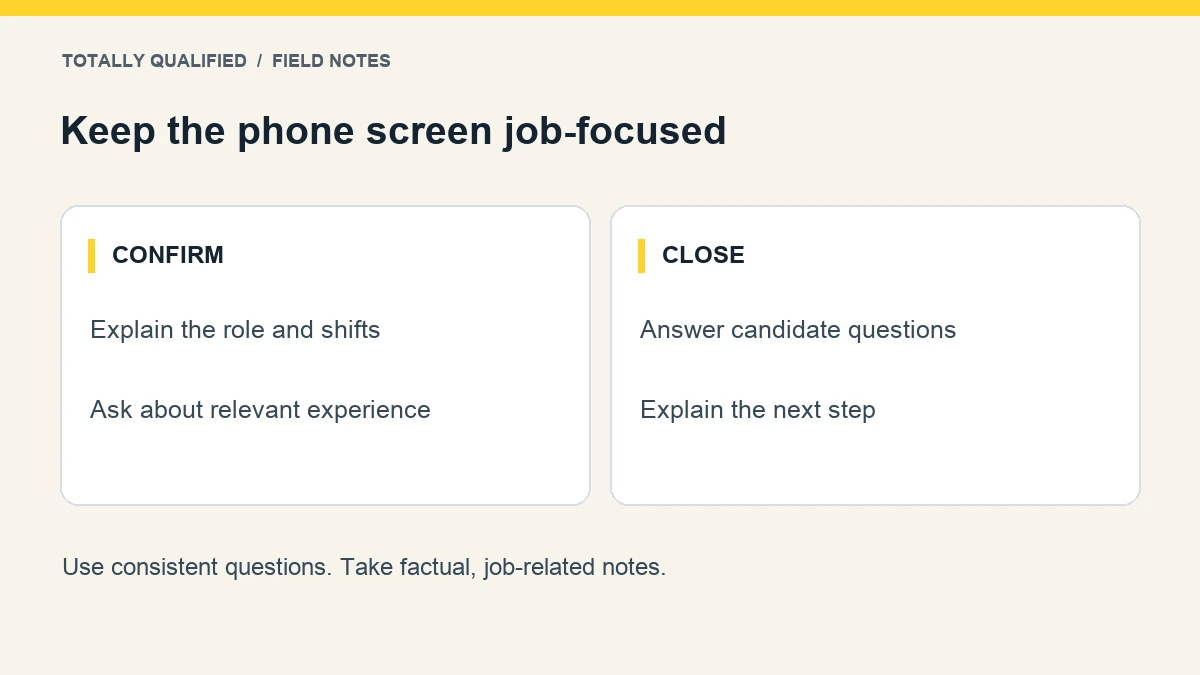
For an hourly opening, a phone screen should establish the basic fit: the actual work, location, pay, required shifts, essential qualifications, and next step. Save the detailed scenarios and deeper assessment for the interview. The call is a two-way check, not a test of how quickly someone can impress you.
Here’s an original 15-minute outline for U.S. small-business hiring. Treat the timing as a planning estimate, not a cutoff that overrides a useful clarification or an accommodation need.
Write the answers you owe the applicant first
Have a one-page role brief in front of you: title, main duties, worksite, pay or genuine range, expected weekly hours, required shifts, start-date needs, and training available. Identify which qualifications are essential at hire and which you can teach.
Use the same core questions and decision criteria for comparable applicants. The Office of Personnel Management’s structured-interview guidance describes that consistency principle. This shorter outline adapts it for an initial conversation; it is not an OPM test or a validated scoring system.
If your ad promises a beginner role, don’t quietly screen out everyone who lacks experience with your exact software. If you need Saturday closing coverage, don’t replace that requirement with the much broader “open availability.”
The call: five questions, with room to listen
1. “Is now still a good time for the call?”
Introduce yourself, confirm the role, and explain the purpose. For example: “I’d like to explain the position, check a few practical details, and leave time for your questions. Then we can decide whether to arrange the full interview.”
Make the call at the agreed time. If the connection is poor or the applicant is somewhere they can’t talk, offer a workable alternative. Background noise or a missed unscheduled call is not a reliable measure of future attendance.
2. “Does this pay, location, and schedule match what you’re looking for?”
Explain those details before asking for agreement. Separate base hourly pay from tips or bonuses. State whether hours are expected, guaranteed, or variable, and explain late finishes or rotating shifts that are genuinely part of the opening.
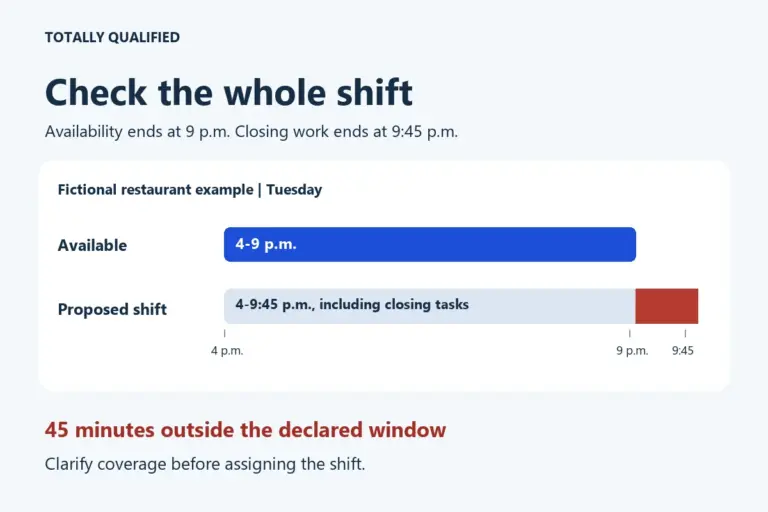
Then confirm the specific days and times. A hypothetical grocery opening might require Tuesday and Thursday from 4 to 9 p.m. and Saturday from noon to 6 p.m. Ask whether those shifts work—not whether the applicant can be available whenever the business wants.
Ask about the job’s pay range, not previous salary. Ask whether the person can get to the stated worksite for the stated shifts, rather than assuming a particular transport arrangement is necessary. If driving is a real job duty, discuss its actual requirements separately.
3. “Which part of this work have you done, and which would be new?”
Read the main duties first, then let the candidate give a short answer. You’re distinguishing relevant experience from training needs, not asking for a complete career history.
For an entry-level role, invite an example from another setting. Someone who has never used your register may still describe accurately checking an order or following a written process. Record what they explained and what remains untested.
If a credential is genuinely required at hire, ask about that credential consistently. Don’t add unnecessary certificates because they look reassuring. For example, our guide to forklift certification before applying explains why a course card is not a substitute for an employer’s equipment- and workplace-specific responsibilities.
4. “If we both decide to move forward, what start date could you realistically manage?”
State your own needs too. If the first training shift is fixed, say so. If there’s flexibility, don’t manufacture a deadline to create urgency.
You need a date, not private details about why someone is unavailable earlier. A request to give notice to another employer doesn’t itself establish low interest in your opening.
5. “What would you need clarified before the next step?”
Leave actual time for the answer. Training, schedule stability, pay, and reporting arrangements are reasonable questions. If you don’t know something, say who will confirm it and when. Don’t guess a benefit or promise a shift you can’t offer.
For planning, allow roughly two minutes for the introduction, four for job details and availability, four for relevant background, two for timing, and three for questions and the next step. These are suggested allocations; some calls will need a different pace.
A small note sheet is enough
Record the job facts confirmed, relevant evidence, unresolved questions, and next action. Keep observations separate from assumptions. These examples show the difference:
- Useful: “Can cover all three advertised shifts; additional Friday availability not confirmed.” Not useful: “Not flexible.”
- Useful: “Has packed orders; would need register training, which this opening provides.” Not useful: “No experience.”
- Useful: “Could start the week after the proposed date; manager to check training coverage.” Not useful: “Not eager.”
Choose among a few clear outcomes: arrange the interview, clarify a specific open point, or explain that the stated requirements don’t align. There is no need for a made-up percentage score that suggests more precision than a short call can support.
Keep hiring notes in an appropriate, access-controlled system under your retention policy. Don’t put personal explanations, identity documents, or medical information into a casual shared scheduling sheet.
When an answer needs a different conversation
Stay with qualifications and the actual schedule. The EEOC advises against non-job-related questions about marriage, children, and childcare arrangements. “Can you work these shifts?” is useful. “Who will look after your children?” is not part of this outline.
The EEOC also explains restrictions on disability-related questions before an offer. Don’t ask about medication, diagnoses, or workers’ compensation claims. Federal ADA employment coverage generally starts at 15 employees; state and local protections may apply to smaller businesses.
If someone raises an accommodation need, use an appropriate process rather than marking the candidate as a schedule mismatch or demanding medical details during this call. This is a practical screening guide, not a complete statement of federal, state, or local hiring law.
Finish with a decision or a specific follow-up
If you’re moving forward, explain the interview format, who will attend, and what it will assess. Confirm the appointment in writing through the agreed contact channel. Our guide to reducing interview no-shows covers the invitation, arrival details, and rescheduling process.
Use the next conversation for deeper job examples. For a restaurant opening, these restaurant interview questions pick up where the practical fit check ends.
If a material detail remains unknown, name it: “I need to confirm whether that later start date works with training. I’ll contact you by Thursday.” If it won’t work, close the loop respectfully. A useful phone screen ends with less uncertainty for both people—not simply one more completed step in your hiring software.