
“Cleaner wanted. Flexible hours. Competitive pay.” That ad leaves nearly every important question unanswered. A person available for evening office work may apply for a daytime house-cleaning route. Someone expecting one workplace may discover that the job involves several customer addresses.
A useful cleaning job posting tells applicants where they’ll work, when they need to be available, what they’ll earn, and what support they’ll get. Below are two original templates you can copy and adapt: one for residential cleaning and one for commercial office cleaning.
These are sample advertisements, not open jobs. Replace every item in braces, remove anything you don’t offer, and check the posting requirements where the employee will work. The templates assume you’re recruiting an employee; they don’t determine whether a role can legally be treated as independent contracting.
Decide which job you’re actually advertising
Choose a specific title such as Residential Cleaner — Weekday Team or Office Cleaner — Evening Shift. “Cleaning specialist” doesn’t tell a candidate whether they’ll enter occupied homes, close an office building, or handle specialist hazards.
O*NET describes housekeeping work and janitorial and building-cleaning work separately. Use those occupational descriptions to check your thinking, not as a list of duties to paste wholesale. A small office-cleaning position shouldn’t quietly include repairs, high-access window work, or hazardous cleanup that your team isn’t equipped to perform.
Before using either template, settle these details:
- Starting point: Does the employee report to your office, a fixed client site, or the first home on a route?
- Schedule: Which days and time windows are required? Are weekly hours fixed, estimated, or variable?
- Travel: Who transports the team between assignments? Is driving part of the job?
- Pay: What is the actual hourly rate or range, and what determines the starting rate?
- Support: Who supplies products, equipment, protective equipment, and training?
- Responsibility: Will the person work with a trainer, a team, or independently?
If you haven’t decided whether you can train a beginner, start with our guide to hiring cleaning employees with no experience. “No experience required” should describe a supported opening, not a hope that someone will figure it out alone.
Template 1: residential cleaning employee
Use this version for a cleaning company serving private homes. Keep customer names, access codes, and exact home addresses out of the public advertisement.
Residential Cleaner — {City or Service Area}
{Business name} is hiring a {part-time/full-time} cleaning employee to help maintain clients’ homes in {service area}. You’ll work {with a team/independently after supervised training} and report to {role of supervisor}.
Pay and schedule
Pay: {actual hourly rate or good-faith range}, with the starting rate based on {job-related criteria}.
Workdays and hours: {specific days and start/end window}.
Expected weekly hours: {number or realistic range; explain whether hours are guaranteed or may vary}.
Benefits offered: {only benefits actually available, with relevant eligibility details; remove if none}.A typical workday
You’ll meet at {general starting location} and clean {type of homes} using the assigned checklist. Tasks include cleaning bathrooms and kitchens, dusting accessible surfaces, vacuuming, mopping, and removing ordinary household trash. You’ll report damage, access problems, or requests outside the assignment to your supervisor. {State any services specifically excluded from this role.}Travel, supplies, and training
{Explain how employees travel between homes, whether driving is required, and any vehicle or reimbursement arrangements.} We provide {actual supplies, equipment, and required protective equipment}. Training covers {actual topics} and is led by {trainer’s role}. {Describe the paid training arrangement and how readiness for independent work is assessed.}What you need
{State whether prior cleaning experience is required or whether beginners are welcome.} You need to follow work instructions, communicate when a problem prevents completion, protect client privacy, and be available for the schedule above. The essential tasks include {accurate physical duties and working conditions, with or without reasonable accommodation}. {Add a driver’s license requirement only if driving is genuinely part of the job.}How to apply
Send {brief work history or resume} and your availability for the listed schedule to {business application link or email}. If selected for the next step, we’ll arrange {your actual interview process}. To request an accommodation in the application process, contact {appropriate business contact}.
The travel paragraph is worth writing carefully. “Reliable transportation” could mean arriving at one meeting point or supplying a vehicle for a route. Those are different commitments. Explain the arrangement so applicants can make a realistic decision.
Template 2: commercial office cleaner
This version fits routine office cleaning. Don’t reuse it unchanged for healthcare facilities, industrial sites, or specialist remediation; the procedures and risks can be substantially different.
Office Cleaner — {Evening/Daytime} Shift — {City or Area}
{Business name} is hiring a {part-time/full-time} cleaning employee for {a fixed office site/several nearby office sites}. You’ll work {alone/as part of a team} after {describe the actual training and supervision arrangement}.
Pay and schedule
Pay: {actual hourly rate or good-faith range and starting-rate criteria}.
Schedule: {days, start time, and finish time or realistic finish window}.
Expected weekly hours: {number or range, including whether they vary}.
Work location: {general location and whether travel between sites is required}.
Benefits offered: {actual benefits and eligibility, or remove}.What you’ll do
Empty ordinary trash and recycling; vacuum or mop designated floors; clean restrooms and break areas; replenish assigned supplies; and check completed areas against the site checklist. You’ll report spills, damage, missing supplies, and access problems through {reporting method}. You’ll follow the building’s rules for occupied rooms, confidential materials, keys, and locking up. {Remove any duty the role doesn’t include.}Equipment and preparation
We provide {equipment, products, and required protective equipment}. You’ll receive instruction on the products and equipment used at the site, the task sequence, and emergency reporting. {Name any equipment experience genuinely required at entry.}Requirements
{Relevant experience required, or explain that entry-level applicants receive training}. Ability to perform {specific essential tasks}, with or without reasonable accommodation; follow site instructions; and work the stated schedule. {Include driving or other qualifications only when tied to actual duties.}Apply
Apply through {business link or email} with {brief work history or resume} and availability for this shift. The next step is {actual process}. Application accommodations: {appropriate business contact}.
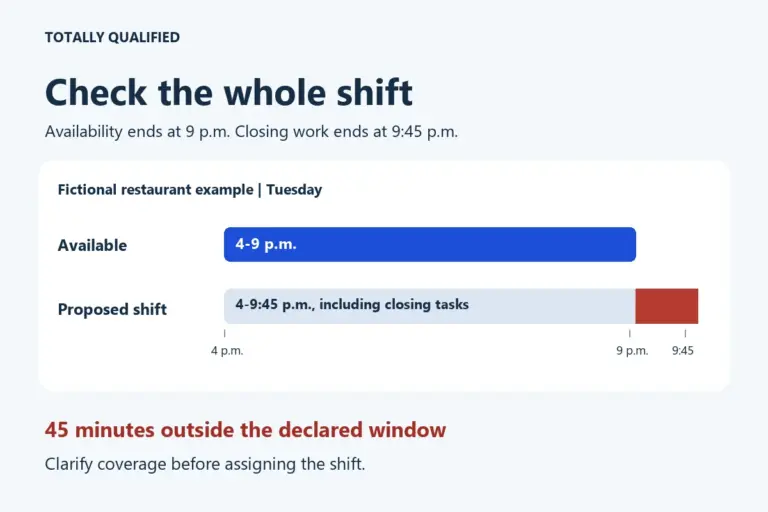
For evening work, specify whether “after 6 p.m.” means a fixed 6–10 p.m. shift or permission to begin at any time after six. Also explain whether the employee will be the only person in the building and how they’ll reach a supervisor. Don’t publish security procedures themselves.
Replace vague promises before you post
Instead of: “Flexible hours, great pay, must have a car.”
Write: “Work {days}, starting at {time}, with an expected finish between {times}. Pay is {rate/range}. Report to {meeting area}; {company transportation arrangement} applies between client sites.”
Flexibility needs a direction: can employees choose shifts, or does the employer change them? A rotating customer schedule isn’t necessarily flexible for the worker. Similarly, don’t combine an hourly base rate, possible tips, and an occasional bonus into one headline number that looks guaranteed.
Explain paid time separately from mileage or other expense arrangements. For covered employees, the U.S. Department of Labor distinguishes ordinary commuting from travel between job sites during the workday; the latter is working time. State and local requirements may add protections. Don’t describe between-client travel as unpaid simply because cleaning isn’t happening during the drive.
Check applicable pay-transparency requirements before posting. The information required in an advertisement varies by jurisdiction; a salary field in a generic template isn’t a complete compliance check.
Keep requirements connected to the work
The Bureau of Labor Statistics reports that janitors and building cleaners typically learn on the job. That doesn’t make experience irrelevant, but it is a reason to reconsider automatic degree requirements for routine entry-level work.
Describe tasks rather than a preferred kind of person. “Young and energetic” gives candidates less useful information than the actual time spent standing, equipment moved, or stairs used. Avoid adding a lifting number copied from another advertisement if it doesn’t reflect this job. The EEOC’s hiring guidance also explains limits on pre-offer questions about disability and other protected information; asking applicants for medical histories isn’t a substitute for describing essential duties.
Don’t expect a job ad to transfer your training responsibilities to the new employee. OSHA and NIOSH explain that workers need training before using hazardous cleaning chemicals. Saying “must know all cleaning products” doesn’t establish that someone understands the products used at your sites.
Read the finished ad as an applicant
Before publishing, have someone unfamiliar with the opening read it. Can they tell you the pay, location, required availability, travel arrangement, and next application step without asking a follow-up question? If not, fix that gap first.
Check that every placeholder is gone, the application link works, and you monitor the listed inbox. Ask only for what you need at this stage; bank details and identity documents don’t belong in an initial public reply. Keep a dated copy so the interview and eventual offer match what applicants saw.
Once responses arrive, use our 15-minute phone screen for hourly workers to confirm fit with the real schedule and duties. For the broader process, browse Hiring Guides. The point of a clearer ad isn’t simply more applications. It’s fewer conversations that end with, “I didn’t realize that was the job.”