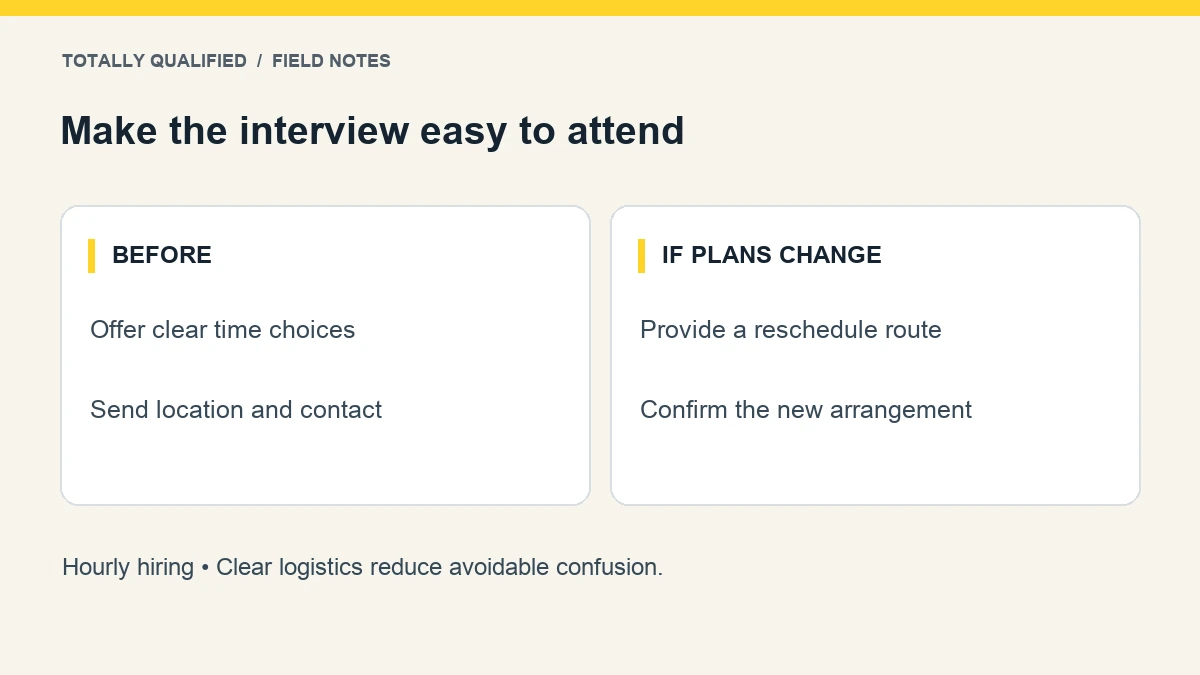
To reduce interview no-shows for hourly jobs, make the appointment easy to understand, confirm that the actual job fits before booking it, and give candidates a simple way to cancel or reschedule. Start there before buying scheduling software or sending more reminders.
If you run a small business, an empty interview slot may mean you left the floor short-staffed or postponed other work. You can’t make every applicant attend. You can stop losing people because they never got a clear time, went to the wrong entrance or learned the real shift only after agreeing to an interview.
The process below is a practical starting point for U.S. employers hiring hourly staff. The message examples are original templates, not a tested formula or a promise of a particular reduction.
First, find out which appointment is going wrong
Check your last few missed interviews before changing the whole hiring process. Did the candidate agree to a specific time, or did you send an invitation and assume it was accepted? Did they cancel in a message nobody checked? Did a manager move the appointment without getting a reply?
Those are different problems. An unaccepted invitation belongs in your follow-up queue. A cancellation is useful information, even if it’s inconvenient. A confirmed appointment missed without notice is the no-show you’re trying to understand.
Don’t guess that people are collecting benefits, being lazy or deliberately wasting your time. You usually don’t know why they disappeared. Record what happened, not a theory about the person.
Settle the pay, shift and location before offering a time
Send the job title, worksite, actual pay range and required shifts before asking someone to travel. A person who needs mornings won’t become an evening employee because your interview went well. Finding that out now saves both of you a trip.
For tipped work, separate base pay from tips. For variable hours, explain what is expected and what is guaranteed. Avoid describing a fixed weekend requirement as a “flexible schedule.” Our restaurant job posting template shows how to make these details clear in the advertisement.
Then offer a small choice of times that you can actually honor. A short phone conversation may be enough for an initial screening; don’t require an in-person trip just to repeat information already in the application. For a store or restaurant, avoid scheduling interviews during a rush unless another manager can cover.
Ask which contact method the applicant prefers. If they agree to interview texts, use a business number someone monitors. A message from an unfamiliar number that says only “come tomorrow” can look suspicious.
Send one confirmation with everything needed to arrive
A calendar invitation can help, but it shouldn’t be the only place the instructions live. Put the details in the message too. Include a full date, time zone, expected duration, address or meeting link, and the name of the interviewer. For a warehouse, explain the visitor entrance rather than assuming the shipping entrance is obvious.
Here is an invitation you can adapt. Replace the brackets, and don’t describe an appointment as confirmed until the candidate has accepted it.
Hi [first name], this is [name] from [business]. We’d like to talk with you about our [job title] opening: [pay details], [required shifts], at [work location]. Would [proposed date and time, including time zone] or [alternative] work for a [duration] interview? If neither works, let me know. You can reply here with questions.
After they choose a time:
You’re confirmed for [day, full date] at [time/time zone] with [interviewer] at [address and entrance, or meeting link]. Please allow [duration]. [What to bring, only if needed.] If your plans change, reply here so we can cancel or find another time. If you need an accommodation for the interview, contact [appropriate business contact].
Check the address and link yourself. Make sure a different employee answering the phone can find the appointment. None of this works if the applicant reaches the business and is told nobody knows about an interview.
Use reminders to resolve confusion, not to chase someone all day
As a starting routine, send a short reminder the day before. For a same-day booking, a separate reminder may add nothing. Adjust to the lead time and the candidate’s chosen contact method; there isn’t one reminder schedule that is right for every business.
Hi [first name], a reminder about your [job title] interview with [business] tomorrow, [full date], at [time/time zone]. We’re meeting at [location/link]. Still works for you? If not, reply here to cancel or reschedule. —[name]
If there’s no reply, check that the original appointment was accepted and the contact details are correct. Don’t quietly give away a confirmed time just because the reminder went unanswered. If you require reconfirmation by a deadline, explain that when booking and tell the person explicitly if the appointment is canceled.
Keep hiring messages about the application. Don’t turn a phone number supplied for an interview into a marketing list. For a handful of candidates, a calendar and a shared hiring log may be enough. Automation becomes useful when real appointments are getting lost—not because a tool promises to eliminate ghosting.
Make rescheduling possible without making assumptions
A candidate may be working another shift, unable to find the entrance, dealing with a broken meeting link or asking for an accommodation. A reply route helps you distinguish those situations from someone who no longer wants the job.
Keep the exchange focused on arranging the interview, rather than demanding personal explanations. The Department of Labor’s interviewing guidance emphasizes accessible procedures and job-related questions. The EEOC explains accommodation obligations and limits on disability-related questions before an offer. Federal ADA employment coverage generally starts at 15 employees; state and local protections may cover smaller businesses. An accommodation request needs appropriate handling, not an automatic “unreliable” label.
If someone misses the appointment, send one neutral follow-up:
Hi [first name], we didn’t connect for today’s interview for [job title]. Are you still interested? If you’d like to discuss another time, reply by [reasonable date]. If you’ve moved on, thanks for letting us know. —[name], [business]
Use a consistent process for deciding whether to offer another slot, while considering accommodation obligations and the actual circumstances. You don’t have to send endless messages. Avoid angry replies or threats to blacklist someone; they don’t fill the vacancy.
Protect the interviewer’s time, then measure what changes
Reserve interview blocks when someone can genuinely step away from operations. Leave enough space to finish the conversation and write notes. Booking several candidates for the same individual appointment may replace an empty chair with a waiting room full of frustrated people.
For restaurant roles, prepare your questions for hourly restaurant candidates before the appointment. Getting someone through the door is only useful if the conversation helps both sides assess the job.
Keep a small log: role, source of application, date booked, agreed interview time, reminder sent, outcome and any operational problem. Record cancellations, reschedules and employer cancellations separately from missed confirmed appointments. Don’t put medical explanations or other sensitive personal details in a shared attendance sheet.
To compare periods, define your measure first. For example: missed confirmed appointments without notice ÷ appointments still scheduled to happen. Exclude appointments canceled or moved beforehand, use the same rule each time, and show the counts beside the percentage. Two misses out of four appointments aren’t a reliable picture of your whole hiring process.
Try one change, such as clearer arrival instructions, and look at the next set of interviews. Track completed interviews and hires too. Fewer no-shows won’t help much if the job details still attract people who can’t work the shift.
Have your invitation message ready before the first response arrives.