
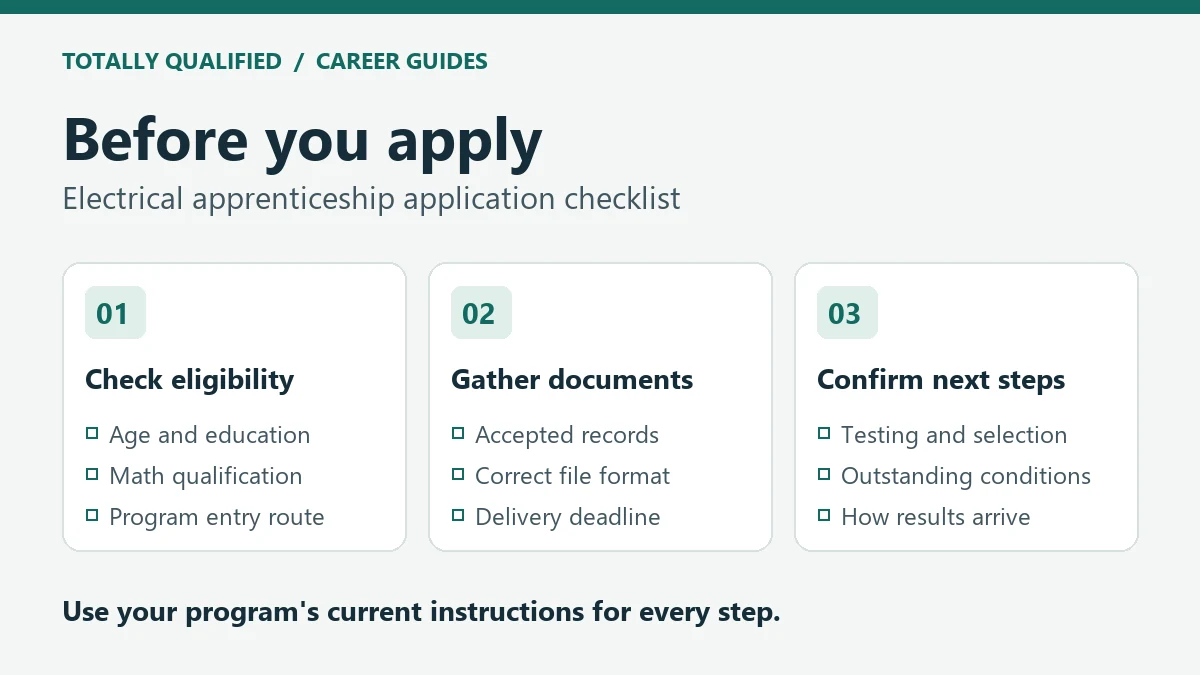
You have found an electrical apprenticeship that looks promising. Before you start the application, check whether you can document the qualifications it asks for. Having completed a course and having the accepted record of that course are two different things.
Electrical apprenticeship requirements are set by the particular program. Check its minimum age, accepted education, math requirement, identification, work-area expectations and selection process. Some programs accept applicants with no electrical experience. Meeting the minimum requirements does not guarantee a place.
This checklist is for first-time U.S. applicants preparing their paperwork. Use it alongside the sponsor’s current application instructions, which control what you must submit and when.
Jump to the checklist · Compare real document requirements · Copy a question about missing paperwork
Start with the exact program and entry route
Save the application page for the occupation you want, not just the training center’s homepage. A center may offer several programs, and an employer may advertise helper work separately from apprenticeship enrollment.
The U.S. Department of Labor’s career-seeker guidance directs applicants to apply through the employer or program sponsor. If you are unsure which organization runs the training, use our guide to checking whether an apprenticeship is registered before assembling a packet for the wrong organization.
Write down four things: the program’s name, the occupation, the application deadline or completion window, and the official contact for questions. Check whether you are applying for an apprenticeship place, a waiting list or a separate job. Our electrician helper vs. apprentice comparison explains why those offers can differ.
Electrical apprenticeship application checklist
These are items to check, not requirements that apply to every program. Beside each relevant item, record the exact instruction and one status: ready, requested or needs clarification. Keep the instruction’s link with your notes.
| Check | Question to resolve | What to prepare |
|---|---|---|
| Age | What is the minimum, and must you meet it when applying or when training starts? | The proof and submission method the program specifies. |
| Education | Which diploma, equivalency or other education route is accepted? | The required transcript, completion record or score report. |
| Math | Which course, grade and length of study qualify? Are alternatives accepted? | A record showing the course and result, or confirmation of an accepted substitute. |
| Identification and travel | Is photo identification enough, or is a valid driver’s license required? Where could you work and attend classes? | Accepted identification and a realistic travel plan. |
| Supporting experience | Are work records, references or recommendations required, optional or irrelevant to this route? | Only the requested evidence, with accurate dates and details. |
| Submission and selection | What are the deadline, fee, file format and next steps? Which conditions apply later? | A complete packet, confirmation of receipt and a list of remaining steps. |
Do not mark an item ready just because you ordered a document. Record when you requested it, how it will arrive and whether the program must receive it directly from the school.
Can you apply without electrical experience?
Yes, some programs explicitly allow it. For example, NECA-IBEW 193 JATC in Springfield, Illinois says prior experience is not required. Its published qualifications still include an age threshold, an accepted education credential and an algebra requirement. It also lists testing and other steps before enrollment.
Use that as a reason to read the entry rules, not as a promise that every opening accepts beginners. Find the route intended for first-time applicants. An alternative route based on documented electrical work hours may not be the route you need.
List your real work and education honestly. If the form asks for electrical experience and you have none, do not rename warehouse, restaurant or household tasks to fill the gap. If references are requested, our guide to choosing references without work experience can help you identify someone who can speak to work you actually did; confirm which kinds the sponsor accepts.
A diploma, a transcript and a screenshot are not interchangeable
A diploma may show that you graduated without showing your algebra course or grade. Read both the education requirement and the instructions for proving it. Two current program examples show why the format matters:
- Central California Electrical Training Institute: its Inside Wireman application instructions say official transcripts are not required for the described upload process and ask for full-page copies. The page specifies evidence of two semesters of algebra or higher math with a grade of C or better.
- Chattanooga Electrical Apprenticeship: its application instructions call for official completed high-school transcripts showing Algebra 1 or GED test scores. They require scanned PDFs, reject screenshots and photographs, and say a high-school diploma does not replace the requested transcript.
These are local examples, not a national document standard. Follow the current instructions for your program. If two sections of its website appear to conflict, ask the admissions contact which instruction governs your application.
Example: qualified coursework, incomplete paperwork
Imagine Jordan, a fictional applicant whose chosen program requires an official transcript showing algebra. Jordan has a diploma and a phone screenshot of a school record. The coursework may satisfy the requirement, but the application packet is not ready.
After ordering the transcript, Jordan records: “Algebra record: requested; official transcript pending.” The next actions are to confirm the delivery method and ask whether it will arrive before the deadline. Uploading the screenshot repeatedly does not resolve a format requirement.
What if you do not have the required algebra record?
First establish whether the problem is missing paperwork or missing coursework. If you took the course, contact the school or records office. If its title is unclear on your transcript, ask the sponsor what additional evidence it will accept.
If you have not completed an accepted course, ask about approved alternatives before paying for one. Springfield’s published qualifications, for example, list a post-high-school algebra course or the NJATC Online Tech Math Course as alternatives to a year of high-school algebra. That acceptance belongs to that program; another sponsor may use different rules.
For a GED or education completed outside the United States, ask which records, evaluations or translations are needed. Do not assume a general credential alone settles a separate math requirement. Get the answer before spending money on a service or course.
Keep eligibility, selection and enrollment separate
Use three lines in your notes:
- Eligibility: Can I document the minimum qualifications for this application route?
- Selection: What assessment, interview or ranking process follows a complete application?
- Enrollment or placement: What further conditions must be met, and who confirms my start?
A submitted form is not an acceptance letter. For a concrete example, CCETI describes an eligibility list ranked by application scores and hiring from that list. Your sponsor’s process may differ, so ask how results arrive and how long an application remains active.
Use the sponsor’s own test instructions for preparation. Do not assume every program uses the same assessment or interview sequence. When you reach that stage, our electrical apprenticeship interview guide explains how to prepare truthful examples from work, school or projects.
Also record when any fee, screening or other condition is due. Asking about timing helps you distinguish paperwork needed now from something requested only after selection.
A message to clarify missing paperwork
Adapt this original example to the requirement you are trying to satisfy:
Hello [program contact], I am preparing a first-time application for [program and occupation]. Your instructions request [document or qualification]. I currently have [record available], and [record requested] is still pending.
Could you confirm the accepted document format and delivery method, when it must arrive, and whether my application can be completed while I wait? If my coursework does not meet the requirement, which alternatives does your program accept?
Thank you. I want to submit the correct materials before the deadline.
Use the official contact listed on the program’s website. A question about document format usually does not require attaching identity documents or your entire school record; use the submission channel the program specifies when those records are requested.
Your final check before submitting
- Open every file and confirm it is complete, readable and in the requested format.
- Match the name and dates across the form and supporting records; ask how to document any legitimate difference.
- Resolve every item marked “needs clarification.” Note any document still pending and the sponsor’s instructions for it.
- Check the exact deadline and whether creating an account starts a separate completion window.
- Save the submitted packet and confirmation. Record the next action and expected way of receiving updates.
The useful outcome is a packet you can explain: what each document proves, what has been received and what happens next. Keep any unresolved requirement visible until the program answers it.
Program instructions checked October 22, 2026. Requirements and application processes can change; use the current notice for the specific program you choose.