
An overnight stocker job description should tell applicants which nights they will work, what they will replenish, and how the advertised pay is calculated. Those details help someone decide whether the opening fits before either side spends time arranging an interview.
Use the original template below for a retail night crew. Replace every bracketed field and remove duties your store does not assign. It is sample hiring copy, not a live vacancy or a description of a particular retailer’s jobs.
Decide what this overnight opening actually covers
Start with the department and reporting line. A dry-grocery stocker who replenishes assigned aisles has a different assignment from someone unloading deliveries, working in freezers, or covering several departments.
O*NET’s Stockers and Order Fillers profile includes receiving merchandise, checking stock, and replenishing shelves. It describes a broad occupation; use it to check your task list, then narrow the posting to your store’s actual work.
For a candidate’s view of the schedule and working conditions, see what an overnight grocery stocker does. If checkout is a major part of the assignment, our grocery store cashier and stocking template may be a better starting point.
Overnight stocker job description template
Overnight Stocker — [Department]
[Store name] · [City, state and work location]
[Part-time or full-time] · [Base hourly pay or good-faith range]
[Required nights and start/end times] · [Expected paid hours per week]
About the role
We are hiring an overnight stocker to replenish [departments] and prepare assigned aisles for [store opening/the next shift]. You will report to [supervisor’s role] and work with [brief description of the night crew]. [State whether the store remains open to customers during the shift.]
What you will do
- Match products to shelf locations and replenish your assigned sections.
- Check item details and quantities using [the store’s scanner, stock list or other system].
- Follow our procedures for product rotation, damaged merchandise and discrepancies.
- Keep work areas clear and report spills, unstable loads or equipment problems promptly.
- Tell the supervisor what remains unfinished and leave a clear handoff for the next shift.
- [If included: Help receive or move deliveries using specified equipment after required training and authorization.]
Schedule and working conditions
Required shifts start at [time] on [nights] and end at [time] the following morning. [Explain fixed or rotating days, weekend requirements and how far ahead schedules are shared.] Expected paid hours are [number or range] per week. [Describe any guaranteed minimum accurately, if offered.]
The role involves [actual essential physical tasks, their frequency and relevant conditions, including cold areas if applicable]. We provide [relevant equipment, assistance and training]. For questions about accommodations during hiring, contact [designated contact or process].
Experience and training
[If true: Previous stocking experience is welcome but not required.] You should be able to follow work instructions, check product details and communicate when an assignment needs attention. Training covers [specific store procedures] with [trainer’s role]. Initial training takes place on [actual days and hours, especially if different from the regular overnight schedule].
Pay and benefits
Base pay is [amount or range] per hour, with starting pay determined by [actual job-related factors]. [If offered: An additional night differential of amount applies to hours worked between stated times.] Pay is issued [frequency]. Benefits for this position include [accurate benefits and key eligibility conditions].
How to apply
Apply through [direct application link or designated method]. Provide [information needed at this stage] and the nights you can work. The next step is [a short call/interview with role]. Interview location and arrival instructions will be provided when scheduling.
Make overnight hours unambiguous
“Sunday through Thursday, 10 p.m.–6 a.m.” can leave applicants wondering whether Friday morning is included. A clearer example is: “Five shifts, starting Sunday, Monday, Tuesday, Wednesday and Thursday at 10 p.m.; each ends at 6 a.m. the following morning.” In that example, the final shift ends Friday morning.
These are illustrative hours, not a recommended schedule. State expected paid weekly hours separately from the time between arrival and departure, and explain the actual break arrangement. If deliveries sometimes change the assignment or finish time, describe that expectation before an applicant accepts.
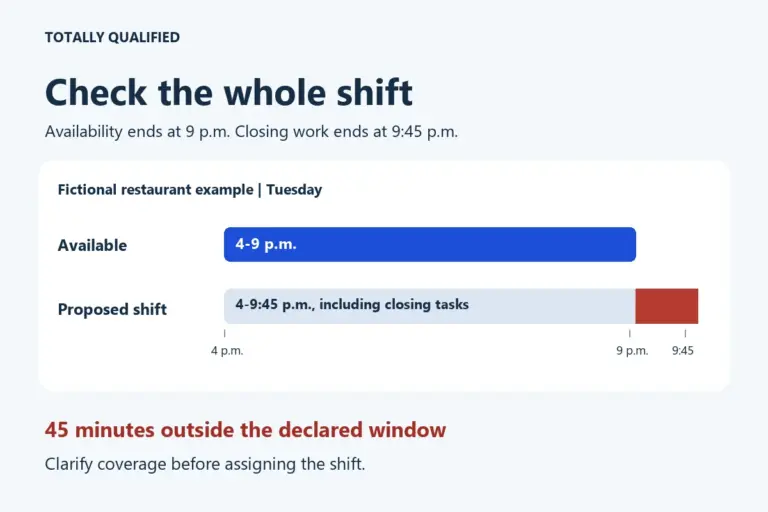
Also disclose daytime onboarding. Someone available every night may still be unable to attend three daytime training sessions without notice. Write both schedules in the posting instead of discovering the conflict after hiring.
Show base pay and any night differential separately
A headline rate can be misleading if it includes an extra payment that only applies during certain hours. A fictional example is: “$18 per hour base pay, plus $1.50 per hour for eligible hours worked between 10 p.m. and 6 a.m.” If daytime training does not qualify for that extra payment, say so. These figures illustrate wording, not market wages.
The U.S. Department of Labor explains that the FLSA does not require extra pay solely for night work. Check the rules and agreements applicable to your workplace before setting the terms. Our shift differential pay guide explains the distinction applicants will want clarified.
For a part-time opening, distinguish the usual schedule from a promised minimum. “Usually scheduled for 24–30 hours” and “a minimum of 24 hours guaranteed” communicate different commitments. Use only wording your business can honor.
Keep requirements tied to the work
Replace “must be young and energetic” with the specific tasks and working conditions. Do not copy a lifting limit, age requirement or certificate requirement from another store without checking whether it applies to this role. The EEOC’s guidance on prohibited employment practices explains restrictions on discriminatory advertising and hiring practices.
If operating a powered industrial truck is part of the job, identify the equipment and training arrangements. OSHA places responsibility on the employer for an appropriate operator training program. A sentence asking for forklift experience does not replace that responsibility.
Connect the posting to a focused interview
Use the same schedule, duties and pay terms in the interview that applicants saw in the advertisement. Ask for real examples of checking work, following instructions and communicating a delay. A first-time applicant may have relevant examples from another job, school or volunteering.
Our overnight stocker interview questions and example answers show how candidates can prepare without inventing experience. You can share that guide before the interview so applicants understand the kinds of work situations you will discuss.
For your own notes, record what each answer demonstrated and what would need training. Keep those notes about the stated job requirements. Avoid rewarding a memorized answer while overlooking whether the actual shift works for the person.
Check the finished posting before sharing it
- The title matches the main assignment, and the department is named.
- Shift start dates and next-morning finish times are clear.
- Paid weekly hours, training hours and pay components are explained.
- Every duty and requirement applies to this opening.
- All placeholders are replaced, and the application link works.
- The posting meets applicable local requirements, including pay disclosures and any restrictions on the tasks or hours assigned.
Have the night supervisor read the final version. If they would need to correct the schedule, equipment duties or training promise during the interview, fix that wording before the advertisement goes out.