
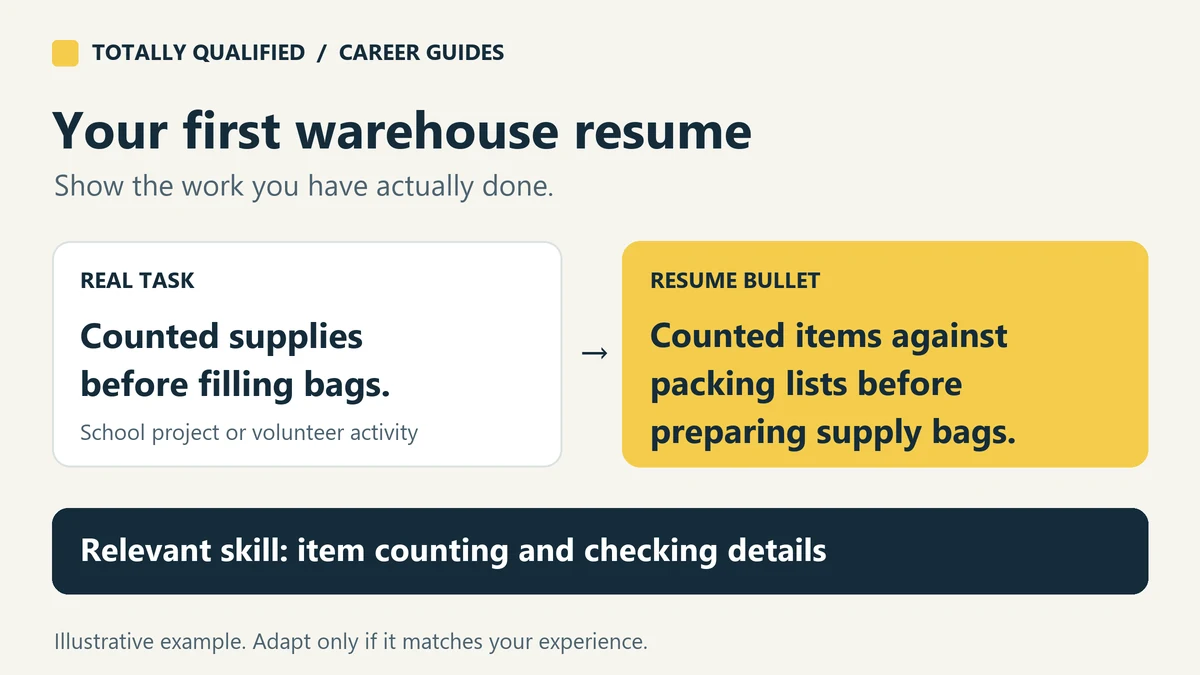
A warehouse resume with no experience should show what you can already do: follow instructions, check details, organize materials and complete tasks reliably. Use examples from other jobs, school or volunteering, then match those examples to the opening. You do not need to describe yourself as an experienced warehouse worker to apply for a beginner role.
This guide includes an original resume example, wording you can adapt and a blank outline. The candidate and activities in the example are fictional. Keep only statements that are true for you, and follow the employer’s application instructions.
Jump to the resume example, skills to include or copyable outline.
Start with the warehouse job you are actually applying for
Save the posting and identify three or four tasks it emphasizes. An order picker opening may focus on finding the correct items and quantities. A packing role may emphasize checking products, preparing cartons and labeling orders. A general warehouse associate position could combine those duties with others.
These distinctions are reflected in O*NET’s profiles for stockers and order fillers and hand packers and packagers. The profiles describe broad occupations, so use the employer’s posting to decide which tasks matter for your application. Our warehouse picker vs. packer guide can help you understand the difference before choosing your examples.
Check the requirements as well. If the employer requires experience operating particular equipment, a well-written beginner resume does not replace it. Look for a trainee opening or ask whether training is available. The first warehouse job guide explains how to compare beginner openings and their training arrangements.
Warehouse resume example with no paid work experience
The fictional candidate below has finished high school and helped with a volunteer supply drive. They have no paid employment or warehouse experience. The example describes what they did without turning a volunteer activity into a warehouse job.
JORDAN LEE
Your city, state · Your phone number · Your email address
SUMMARY
High school graduate seeking an entry-level warehouse associate role. Volunteer experience sorting supplies, checking quantities against lists and preparing labeled bags. Ready to learn the employer’s order-handling procedures.
RELEVANT EXPERIENCE
Volunteer, Community Supply Drive
June–September 2026
- Sorted donated school supplies by item type and placed them in labeled storage areas.
- Counted items against packing lists before preparing supply bags for collection.
- Reported missing or damaged items to the coordinator instead of making substitutions.
- Checked completed bags with another volunteer and returned unused supplies to their assigned locations.
EDUCATION
High School Diploma, Example High School
Graduated June 2026
SKILLS
Item counting · Following written checklists · Sorting and labeling supplies · Reporting discrepancies · Working with a partner
Why this works: the summary identifies the target role, while the bullets provide evidence for the skills listed below it. The candidate does not claim inventory-system experience, forklift training or a warehouse productivity record. The contact line uses placeholders; replace it with your details before sending.
Copy this structure into a document and keep the finished resume to one readable page if your relevant history fits. The example is an editorial model, not a record of a successful application or a promise of an interview.
What if you have worked before, just not in a warehouse?
Include your real job title, employer and dates. Describe the tasks that connect to this opening. A restaurant worker might have checked takeout orders against tickets; a store assistant might have counted products and flagged damaged packaging. Neither needs to rename the role “warehouse associate.”
A short summary could say: “Restaurant team member moving into an entry-level warehouse role, with experience checking orders, organizing supplies and communicating missing items.” Use that wording only if those were part of your work.
Build each bullet around what you did, what you checked and how you handled a problem. For example:
- Too vague: “Hard worker with great attention to detail.”
- More useful, if accurate: “Checked takeout bags against order tickets and flagged missing items before customer pickup.”
You can describe the process without adding a made-up result such as “100% accuracy” or “improved efficiency by 30%.” Include numbers when you know what they measure and can explain where they came from.
Warehouse resume skills: choose the ones you can demonstrate
A skills section should help the reader understand your examples. Start with the posting, then ask what you have actually done that supports each skill. The examples below are illustrative wording, not a list to copy in full.
Item counting and checking details
If you counted supplies for a club, event or previous employer, describe the real activity: “Counted equipment against the return checklist and reported missing pieces to the organizer.” That is more informative than simply writing “inventory expert.”
Organizing and labeling materials
Use an example of putting items into an understandable system: “Grouped event materials by activity and labeled storage boxes for the setup team.” Keep the original context visible; organizing an event is useful evidence, but it is not warehouse employment.
Following instructions and reporting exceptions
A beginner can demonstrate a checking habit without knowing a warehouse’s procedures. For example: “Followed a written assembly checklist and asked the project lead to confirm missing parts before continuing.” Be prepared to explain the situation if an interviewer asks.
Computer or equipment skills
Name the tool and the task you can perform. “Entered quantities into an existing Excel sheet” says more than “computer proficient.” Using a spreadsheet does not mean you have used a warehouse management system.
Leave out forklift operation, powered pallet jacks, warehouse scanners and certifications you do not have. Watching a demonstration or reading about a tool is different from using it. If you completed relevant training, list its exact name, provider and completion date without expanding what the credential establishes.
Adjust the emphasis for picker and packer openings
You can adapt one honest resume without inventing a new work history for each job.
- For a picker opening: put examples involving lists, item identification, quantities and locating materials near the top. Explain how you checked that you had the right items.
- For a packer opening: emphasize checking contents, preparing containers, labeling and noticing damage when those tasks appear in the ad and match your experience.
- For a combined role: show one example of selecting items and another of checking or preparing them for handoff.
Use the posting’s terminology where it accurately describes your experience. Do not repeat every keyword or claim software knowledge just because the ad names a system. Your resume should still make sense when someone asks you to explain any line.
A simple warehouse resume outline to copy
Use the outline below in your preferred document editor. Replace the prompts with your information and remove sections that do not apply. If you have paid work experience, list it with the most recent role first.
YOUR NAME
City, state · Phone · Email
SUMMARY
Target role + relevant background + one or two skills supported below.
EXPERIENCE OR RELEVANT ACTIVITIES
Actual role or activity · Employer, school or organization · Dates
- Action you took + materials, orders or information involved.
- How you checked your work or followed instructions.
- A problem you reported, handoff you completed or result you can explain.
EDUCATION
Credential earned, or current program with expected completion clearly labeled · School · Date
SKILLS
A short list of relevant abilities you can demonstrate.
RELEVANT TRAINING, IF ANY
Exact course or credential · Provider · Completion date
If you have no job or volunteer history, consider a real school project, organized activity or informal responsibility that shows relevant work. Label it accurately and explain your own contribution. If none fits, keep the document brief and focus on education and specific abilities you can demonstrate. Do not invent an activity to fill space.
Where do availability and references belong?
When the application has a separate schedule section, complete it there. A short availability line can help when the posting asks for it or the shift is central to your application. Keep it consistent with what you can reliably work. Our guide to putting availability on a resume explains when to include it and where it fits.
Prepare references separately and provide them when requested. Ask each person first. If you have never had a manager, the guide to job references with no work experience explains how to identify someone who has actually seen you handle responsibilities.
Check the finished resume before you send it
Keep the layout easy to scan, use clear section headings and check spelling and dates. Harvard’s resume-writing guide recommends specific, factual language, consistent formatting and checking the result after converting a document to PDF. Its examples serve a different audience, but those editing principles apply here.
- Check that the summary names the role you are applying for.
- Make sure every skill has a real example behind it.
- Keep volunteer activities, paid work and unfinished education clearly identified.
- Remove unused prompts, unsupported numbers and credentials you do not hold.
- Confirm that your phone number and email are correct.
- Use the file type requested by the employer, then reopen the saved file to check its layout.
The finished page should give an employer a clear starting point for a conversation: what you have done, what connects to this job and what you would need to learn.