
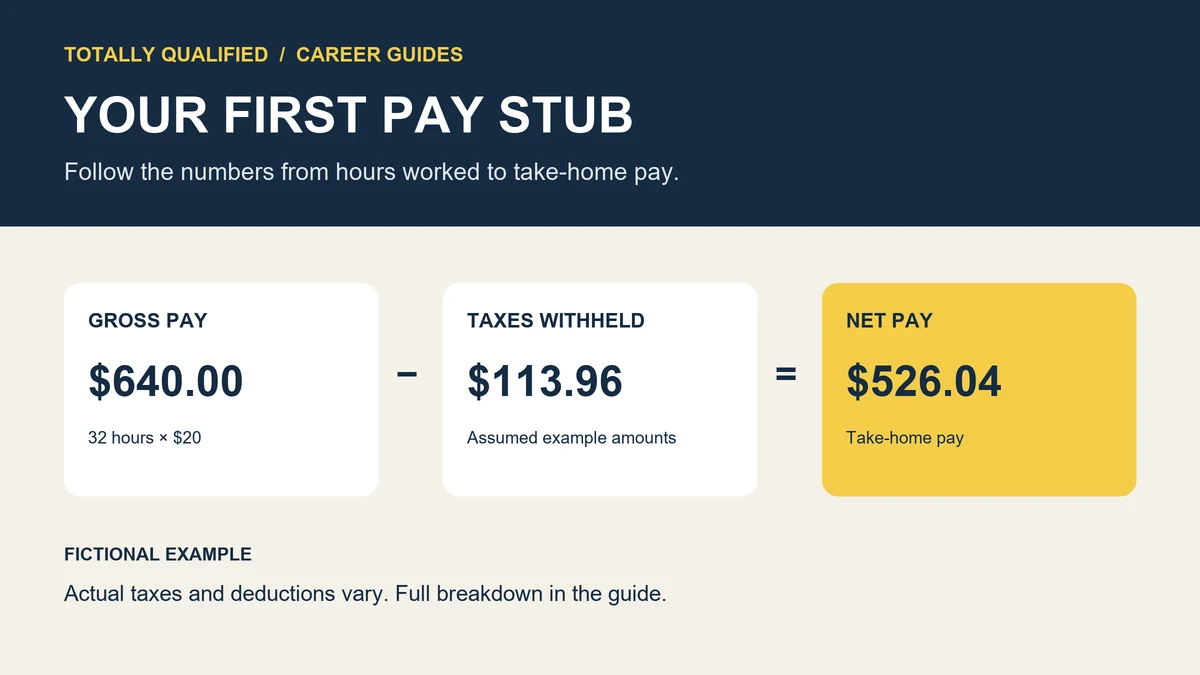
To read your first pay stub, check the pay-period dates, match the hours and rates to your work records, then follow the deductions from gross pay to net pay. The amount deposited in your bank account is the end of that calculation. The statement helps you see how payroll reached it.
This guide is for U.S. hourly employees receiving a wage statement, whether on paper or in a payroll portal. Below is an original, fictional example you can work through alongside your own statement. It explains the fields; it does not estimate your personal taxes.
Start with the dates and the current-pay column
Find the employer name, your name, the pay period and the pay date. The period identifies the work dates covered; the pay date identifies when the payment is issued. Use the column labeled “Current,” “This period” or similar for this payment. “YTD” means year to date.
Keep your time record next to the statement. If you started halfway through a payroll cycle, compare only the days included in that cycle. For questions about the payment schedule itself, see when your first paycheck arrives at a new job.
A first pay stub example: 32 paid hours at $20
Imagine a new employee whose first weekly statement covers November 2–8, 2026, with a pay date of November 13. The agreed rate is $20 per hour for both regular work and orientation. The employee recorded 30 hours on ordinary shifts and 2 hours at orientation. There is no overtime, bonus, reimbursement or benefit deduction in this example.
The federal and state income-tax amounts below are invented assumptions for the arithmetic, not tax-table results. We assume all $640 is subject to Social Security and Medicare, with no wage-limit issue or Additional Medicare Tax. Actual withholding depends on the worker and applicable rules.
| Statement line | Calculation or meaning | Amount |
|---|---|---|
| Regular earnings | 30 hours × $20 | $600.00 |
| Orientation earnings | 2 hours × $20 | $40.00 |
| Gross pay | Total earnings before deductions | $640.00 |
| Social Security | $640 × 6.2% | −$39.68 |
| Medicare | $640 × 1.45% | −$9.28 |
| Federal income tax | Assumed withholding for this example | −$50.00 |
| State income tax | Assumed withholding; not applicable everywhere | −$15.00 |
| Other deductions | None in this example | $0.00 |
| Total withheld | $39.68 + $9.28 + $50 + $15 | −$113.96 |
| Net pay | $640 − $113.96 | $526.04 |
The check works in two directions: 30 + 2 gives 32 paid hours, and $640 − $113.96 gives $526.04. If this is the employee’s first payment of the year in this employer’s payroll, with no earlier balances or adjustments, the current and YTD totals would match.
The CFPB’s pay-stub guide explains gross wages, deductions, net pay and YTD totals. Our example uses a different fictional layout and amounts so you can practice checking the calculation.
Check hours and rates before questioning the deposit
Read all earnings lines. In the example, looking only at “Regular” would make two paid hours appear to be missing. Another employer might combine all 32 hours on one line. Ask which codes include training and compare the total with your records. Our guide to whether job orientation is paid explains the training-time question in more detail.
Check how time is displayed, too. In decimal hours, 7.50 means seven hours and thirty minutes, because half an hour is 0.50. Seven hours and fifteen minutes is 7.25. Do not read a decimal entry as hours and minutes without checking the payroll format.
Overtime can appear in more than one format
For a separate, simple example, assume a covered, nonexempt employee works 45 hours in one workweek at a $20 regular rate, with no bonuses or premiums affecting that rate. Gross earnings are $950:
- Full overtime-rate layout: 40 × $20 = $800, plus 5 × $30 = $150.
- Separate overtime-premium layout: 45 × $20 = $900, plus 5 × $10 = $50.
Both examples reach $950. A line showing a $10 overtime premium does not, by itself, mean the employee received only $10 for each overtime hour. Check whether the base pay for those hours appears elsewhere.
The Department of Labor’s federal overtime guidance generally requires at least 1.5 times the regular rate after 40 hours in a workweek for covered, nonexempt employees. A two-week pay period does not generally let an employer average the weeks to avoid overtime. State rules and special arrangements can differ. If your statement includes night premiums, see how shift differential pay interacts with overtime.
Separate taxes, benefits and employer contributions
“Deductions” can include several different items. Read each label rather than treating the entire difference between gross and net as income tax.
- Federal income tax: withholding toward your federal income-tax bill. Labels may include FIT or federal withholding.
- Social Security and Medicare: payroll taxes, sometimes labeled OASDI, SS or MED. They may appear separately or under a FICA heading.
- State or local taxes: depend on the applicable jurisdiction. Your statement may have different lines from the example.
- Benefit or other deductions: may include your share of insurance premiums, retirement contributions or other specifically identified amounts.
The example uses the employee rates currently listed in IRS Topic 751: 6.2% for Social Security and 1.45% for Medicare. Those rates are applied to the relevant taxable wages, which are not always identical to gross pay. Social Security has an annual wage limit; Additional Medicare Tax can apply above its threshold.
Some statements also display employer contributions for information. Do not subtract those amounts from your pay again unless they are actually included in the employee deduction calculation.
Pre-tax and after-tax benefits can affect different tax bases differently. The IRS Employer’s Tax Guide describes the treatment of different payments and benefits. If a taxable-wages figure differs from gross pay, ask payroll which items explain the difference instead of applying one percentage to everything.
For an unfamiliar insurance deduction, check the plan name, your election and the coverage period it pays for. A deduction line alone does not settle your coverage start date. Our guide to when health insurance starts at a new job explains what to confirm with the benefits administrator.
Use YTD to track totals, not this week’s take-home pay
Year-to-date figures accumulate the amounts recorded during the year. They are not an additional payment. On a later statement, compare its current earnings and deductions with the change in the corresponding YTD figures. Adjustments can affect that comparison, so ask about unexplained differences.
A simple arithmetic example: after the $640 gross payment above, a second payment with $800 gross would bring YTD gross to $1,440, assuming no corrections or other earnings. That does not make the second payment $1,440. Keep gross-to-gross and net-to-net comparisons separate.
Compare net pay with the payment you actually receive
In the fictional statement, one deposit would be $526.04. If you requested split direct deposit, add the amounts sent to your accounts before comparing them with net pay. For instance, $50 to savings and $476.04 to checking still total $526.04.
Do not copy the example’s withholding amounts or infer a standard take-home percentage. A coworker earning the same hourly rate may have different withholding and benefit elections. For a federal withholding check, the IRS Tax Withholding Estimator explains who can use it and which pay statements to have ready. It is not a state-tax calculator.
If something does not match, send payroll a specific question
Before contacting payroll, identify the pay-period dates, the line you cannot reconcile and the supporting work record. Check these five points:
- Are the disputed work dates included in this statement?
- Do the earnings lines account for all the hours and agreed rates?
- Does another line already include the training time or overtime base pay?
- Can you identify each deduction and its amount?
- Do all payment allocations add up to the amount shown as paid?
Here is an original message you can adapt:
Hi Payroll, I’m reviewing my statement for [pay-period dates]. It shows [line and amount], but my [time record or agreed rate] shows [specific difference]. I checked the other earnings lines and still cannot reconcile it. Could you explain the calculation and, if a correction is needed, confirm the amount and payment date? I can provide the relevant record through our secure payroll channel.
Keep a copy of the statement, your work record and the response. Share documents through the employer’s appropriate private channel, and avoid posting an unredacted pay stub publicly. If a wage issue remains unresolved, the Department of Labor’s complaint guidance explains how to contact its Wage and Hour Division; state labor agencies handle applicable state wage rules.
Your first useful check is small: find the period, reconcile the hours, then follow the deductions to the payment. That gives you a concrete question when a number needs explaining.