
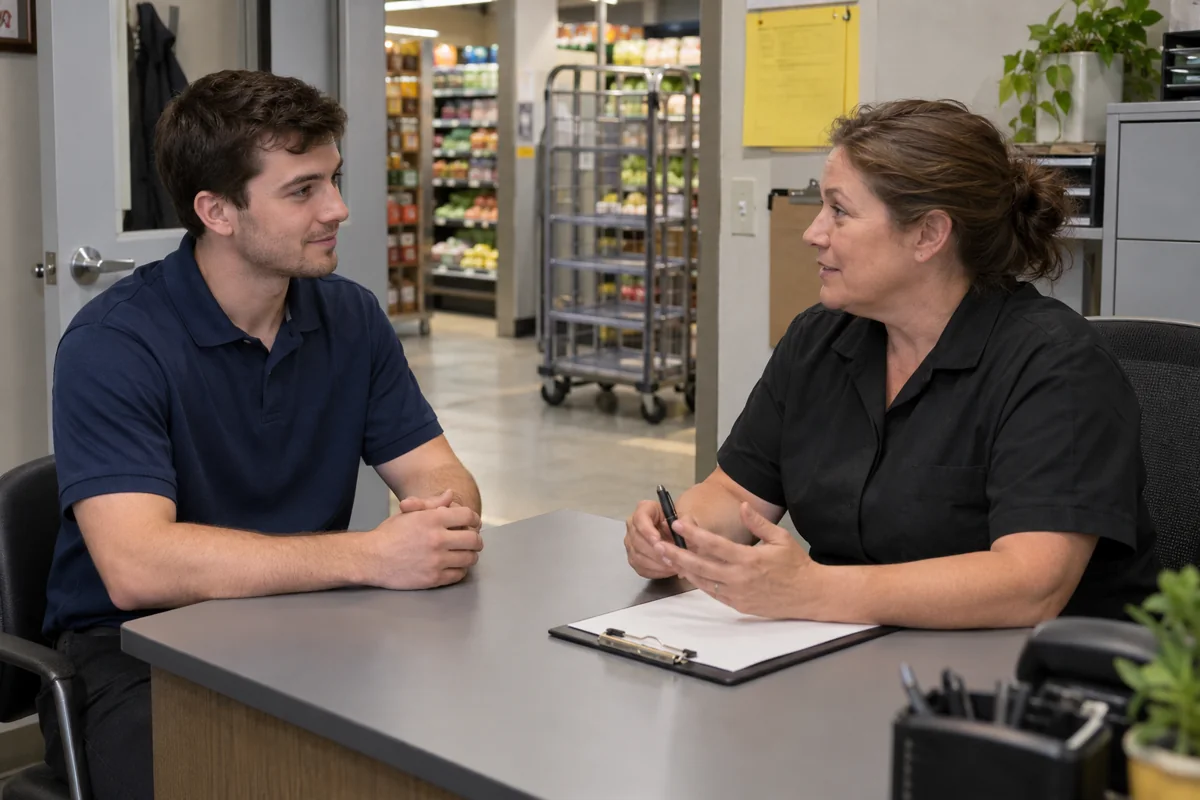
You don’t need a made-up warehouse story to answer overnight stocker interview questions. If this would be your first stocking job, explain what you’ve done before, how you follow instructions, and whether the actual overnight schedule works for you.
A useful answer gives the interviewer something specific to evaluate. “I’m a hard worker” doesn’t tell them much. A short example of finishing a task accurately, asking about a mistake, or showing up for an early commitment does.
The questions below are original practice prompts—not a leaked script or a guarantee of what Walmart, Target, or another employer will ask. Adapt the examples to your own experience instead of memorizing them.
Know which overnight job you’re interviewing for
A grocery stocker, a big-box replenishment associate, and a warehouse order filler can have different routines. Read the opening you’re applying to. Look for the department, shift times, physical tasks, equipment, and whether customer assistance is part of the role.
O*NET’s Stockers and Order Fillers profile covers a broad occupation that includes receiving and storing merchandise, filling shelves or orders, and checking items. It isn’t a job description for every overnight shift.
If you’re still deciding whether the work suits you, start with what an overnight grocery stocker actually does. For the interview, bring the specific posting—not assumptions about what all stores do at night.
“Why do you want to work overnight?”
You don’t need to claim a lifelong passion for stocking shelves. Explain why the schedule and work fit, without pretending nights are effortless.
“I’m interested in work where I can stay active and see what I’ve completed during the shift. The posted hours fit my current schedule, and I’ve checked my transportation for both the start and finish times. I haven’t worked a full overnight schedule before, so I’d like to understand how consistent the shifts are.”
That answer acknowledges the gap. Use it only if the transportation and schedule details are true. “I stay up late anyway” isn’t the same as having a workable plan for repeated overnight shifts.
Don’t describe the job as a way to avoid people. Overnight work can still require coordination with coworkers, supervisors, delivery staff, and sometimes customers.
“You haven’t stocked shelves before. What experience would help you?”
Choose a real task that required accuracy or organization. It could come from paid work, volunteering, or a school activity. Explain what you did and how you checked the result.
“I haven’t had a stocking job. At a community event, I helped sort supplies by table and checked them against a list before setup. When something was missing, I asked the organizer rather than substituting it without checking. I’d need training on your system, but I’m comfortable working from instructions and checking my work.”
This is a fictional example. If you’ve never done that activity, choose another. Maybe you prepared restaurant orders, counted equipment after practice, or organized materials for a class project. The example can be modest; it needs to be yours.
If you don’t have a close comparison, say so and discuss how you approach unfamiliar tasks. Don’t claim experience with scanners, inventory software, pallet jacks, or other equipment you haven’t used.
“Can you work this schedule consistently?”
Be precise about start times, days, and restrictions. “Anytime” can create a problem if you have morning classes, another job, or a commute that doesn’t work when public transportation stops running.
Overnight shifts cross calendar dates. If you’re free on Monday night but not Tuesday night, explain the actual hours rather than simply saying “Mondays and Tuesdays.” Confirm which date the employer uses to label the shift.
A straightforward answer might be: “I can start at 10 p.m. Sunday through Thursday and work until 6 a.m. the following morning. I can’t take Friday-night shifts. Does that match the opening?”
Adjust those times to your circumstances. Our job application availability guide can help you write the same limits consistently on the form.
“What would you do if you couldn’t finish your assigned area?”
Practice explaining how you’d communicate a delay before it becomes a last-minute surprise. The goal isn’t to promise you’ll always finish everything.
“I’d let the supervisor know what remains and what’s slowing me down while there’s still time to adjust. I’d ask which items to prioritize and follow that direction. Before handing off, I’d make clear what was completed and what still needs attention.”
If the issue were an unfamiliar process, you’d ask for clarification. If it were a damaged shipment or another interruption, you’d describe that fact without blaming a coworker. Avoid saying you’d skip required checks to hit a speed target.
“What if you find a damaged item or the shelf label doesn’t match?”
This is a chance to show that you won’t guess just to keep moving. A reasonable practice answer is to check the item information, alert the appropriate coworker or supervisor, and follow the store’s process.
You don’t need to invent a detailed damage-report procedure. You haven’t been trained by that store yet. Say you’d learn its rules for damaged goods, price discrepancies, and misplaced products.
Likewise, don’t promise to lift an unsafe load alone or operate unfamiliar equipment to prove you’re committed. If asked about physical duties, discuss the actual requirements honestly and ask what equipment, training, and assistance the job provides.
“Tell me about a time you worked with someone under pressure”
Pick one incident, not a description of your personality. Explain the situation, your action, and the outcome in a few sentences.
For example, someone with restaurant experience could describe how they coordinated takeout orders when the kitchen was behind. Someone with volunteer experience might describe dividing setup tasks when an event started early. Include what you did rather than taking credit for the whole team.
CareerOneStop recommends practicing with real examples from education and work and preparing questions of your own. Try saying your example aloud. If it takes several minutes to reach the point, shorten the background.
You don’t need a dramatic success story. Catching an error, asking for help, and preventing confusion can make a clearer answer than claiming you single-handedly saved a shift.
Ask questions that reveal what accepting the job would mean
Before you leave, choose the questions the interview hasn’t already answered. You shouldn’t need to ask all of these in order.
- Schedule: “What are the usual start and end times, and how far ahead is the schedule posted?”
- Hours: “Is this a regular number of weekly hours or does it vary?”
- Training: “Who trains a new stocker, and what would I be expected to handle during the first week?”
- Workload: “How do you decide which tasks take priority when a delivery is late or the shift is short-staffed?”
- Pay: “Is the advertised rate the base rate, or does it include an overnight differential?”
If a differential applies, ask which hours qualify and whether it changes during daytime training. Our shift differential pay guide explains the distinction. Don’t assume every overnight job pays a premium.
For a part-time opening, an estimated schedule isn’t necessarily a promise of a minimum number of hours. See what to ask about guaranteed part-time hours before building a budget around the offer.
A short preparation plan for the day before
Save the job description. Write down your actual availability, one example of accurate work, and one example of teamwork. Check where to enter the building for the interview; a store’s interview instructions may differ from its normal customer entrance.
Prepare practical questions and confirm the interview time, especially if the message uses an overnight hour. Bring any documents the employer specifically requested, but don’t put sensitive personal information into a public message or send it to an unverified contact.
At the end, ask what happens next and how they’ll contact you. A clear next step is more useful than trying to guess whether a friendly conversation meant you were hired.