
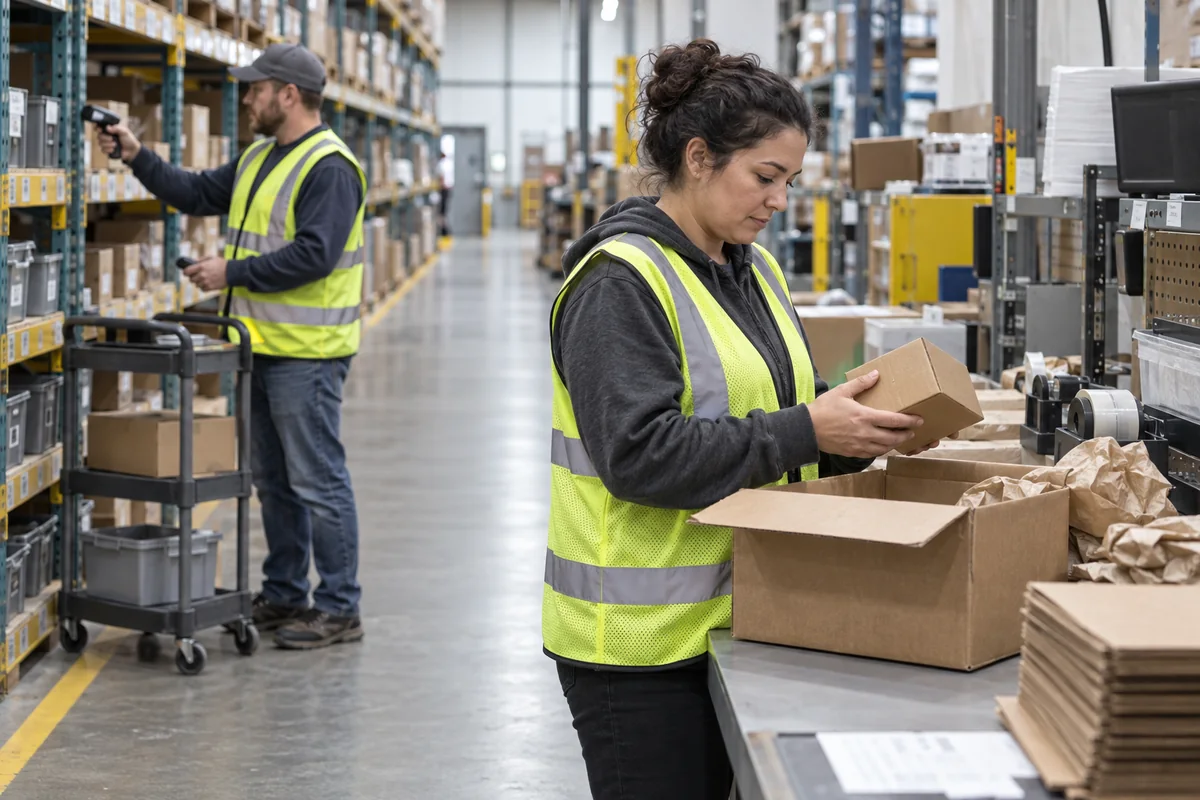
A warehouse picker retrieves the items needed for an order. A packer checks and prepares those items for shipment. A picker-packer opening may combine both jobs, and a broad “warehouse associate” title may include either task plus others.
That distinction helps you read an ad, but it doesn’t tell you which opening will suit you better. The product, equipment, pace and workstation can matter more than the title. Packing heavy parts isn’t automatically easier than picking small items, and picking doesn’t always mean walking miles through shelves.
Picker vs. packer vs. picker-packer: a quick comparison
| Role | Typical focus and what to clarify |
|---|---|
| Picker | Find the items on an order and check their identity and quantity before moving them to the next stage. Ask whether you travel to stock or work at a station where products arrive. |
| Packer | Check the products, use the specified packaging, and prepare the shipment and its labels. Ask whether you pack varied orders or repeat one process on a line. |
| Picker-packer | Perform both sets of duties. Ask whether you follow an order through both stages or switch assignments during the shift, and how training covers each task. |
These are role summaries, not a universal job description. A combined title does not establish an equal split between tasks, a higher pay rate or a lighter workload.
What does a picker-packer do? Follow one order
In a combined role, you may select the products and then pack them yourself, or move between picking and packing assignments as directed. Ask how the work is divided at that facility. O*NET even lists “Picker and Packer” among the reported titles in its hand packers and packagers profile; the label alone still does not define your shift.
Illustrative order: two blue shirts in size medium and one mug. Here is how the two jobs connect in a simple manual workflow. It is a teaching example, not an instruction to override a workplace’s scanning, packing or safety procedures.
- Read the order before selecting stock. Identify the product code, size, color and quantity. A blue shirt in size large may look right from a distance and still be the wrong item.
- Keep the selected items tied to the right order. Use the assigned tote, cart position or other identification system. Follow the site’s scanning steps; do not assume that nearby items belong together.
- Check again at packing. Compare the actual contents with the order: two medium blue shirts and one undamaged mug. If you picked the items yourself, memory is not a substitute for the required check.
- Prepare the shipment using the specified method. Use the assigned packaging and protection, complete the required label checks, and send the finished package to its designated next stage.
O*NET’s stockers and order fillers profile includes reading orders, obtaining items and keeping records. Its hand packers and packagers profile includes inspecting products, counting or weighing, assembling containers, sealing and labeling. These are broader occupations than one employer’s warehouse role.
The handoff matters. A picker can retrieve the wrong size perfectly on time; a packer can seal that mistake into a very neat box. Speed alone doesn’t describe good performance in either job.
What if the order cannot be completed as expected?
- The product is the wrong variant. Do not substitute a different size or color on your own. Report the mismatch through the site’s process and ask who authorizes the next step.
- Only one of the two shirts is available. Report the actual quantity and location rather than marking the order complete. Whether to search another location, wait or split a shipment is a workplace decision.
- The mug is damaged. Do not pack it as acceptable stock. Follow the site’s handling and reporting instructions and ask how a replacement is obtained.
- The shipping label does not match or will not scan. Pause that shipment and get the approved correction. Reusing another parcel’s label would create a different problem.
Before your first independent assignment, ask: “Where do I leave an order that needs a decision, and who do I tell?” Knowing that route helps you report the problem without quietly passing it to the next person.
Compare the actual work, not “easy” versus “hard”
Picking: location and item accuracy
You may follow a handheld scanner, a pick list or another site-specific system. Ask whether you walk to inventory, work from a station where items arrive, or use equipment after training. A title doesn’t establish how much walking, reaching or lifting you’ll do.
A useful interview question is: “What does a new picker do when the item in the location doesn’t match the order?” The answer should explain how to flag the exception and get help. Guessing at a substitute to keep the rate up is different from following an approved process.
Packing: repeated checks and consistent handling
A packing station may involve repeated reaching, standing and handling throughout the shift. The work can include checking condition, selecting materials, verifying quantities and dealing with labels. Some lines have tightly defined packaging; others require more judgment about protection and container size.
Ask to see or hear a description of a typical order. Packing one small cosmetic item and packing a mixed order with fragile goods place different demands on a worker. Find out who resolves a damaged item or a shipping label that won’t scan.
OSHA’s warehousing guidance identifies material handling, ergonomics, vehicle traffic and slips or trips among warehouse hazards. A fixed station isn’t a promise of light work. Ask about lifting aids, workstation setup, training and how to report a problem; an article can’t assess the safety of an unseen workplace.
Seven details to get from the recruiter
Use these questions to compare two openings side by side. You don’t need polished recruiting terminology—specific answers are more useful.
- What occupies most of the shift? Picking, packing, replenishing, loading and cleaning are different duties. Ask whether employees rotate.
- What products and package sizes will I handle? Ask about typical and maximum weights, frequency and available assistance.
- Where does the work happen? Clarify a fixed station, walking routes, refrigerated areas and equipment use.
- How are beginners trained? Find out who demonstrates the task, checks understanding and answers questions.
- How is performance measured? Ask about accuracy, output and the learning period. In a combined role, ask how time spent changing tasks or resolving an order problem is recorded. Don’t assume another warehouse’s target applies.
- What are the exact hours and pay terms? Confirm the base rate, any conditional premiums, breaks and overtime arrangements.
- Who is the employer? A staffing-agency assignment and a direct-hire position can have different terms even inside the same building.
If the recruiter can only repeat “general warehouse duties,” ask for the written job description or clarification from the site. That uncertainty is information worth carrying into your decision.
Which one pays more?
There’s no reliable rule that a picker always earns more than a packer, or the reverse. Compare current offers for the same area, schedule and employment arrangement. A higher overnight rate may reflect the shift rather than a more valuable title.
Keep base pay separate from attendance bonuses, production incentives and amounts advertised as “up to.” If a premium is involved, our shift differential guide explains which questions make the comparison meaningful. Check expected hours as well: a higher hourly rate doesn’t guarantee a higher weekly paycheck.
We haven’t assigned a national picker-versus-packer salary gap here. Occupational data and job titles don’t map neatly enough to justify a universal difference for these two labels.
Applying without warehouse experience
Look for openings that actually offer training. You can describe relevant experience checking orders, organizing materials or following a repeatable process without claiming you’ve used a warehouse system before. Use a truthful example, not a borrowed productivity number.
Choose an example that shows what you actually did:
- Checking details: matching sizes, quantities or names against a list, rather than saying only “good attention to detail.”
- Keeping items organized: separating different orders or groups of supplies so they reach the right person.
- Reporting discrepancies: telling the person responsible when an item is missing or does not match, instead of guessing.
Paid work, volunteering or a school project can supply an example if it is relevant and true. Keep equipment claims separate: following a checklist does not mean you already know an employer’s scanner or warehouse software. Our warehouse resume example for applicants with no experience shows how to describe that evidence without inventing warehouse experience.
The first warehouse job guide covers applications and first-day preparation. If an opening includes powered equipment, read what forklift certification does and doesn’t establish before buying a course or claiming you’re qualified to operate it.
Once you’ve found options on employer careers pages, write down one sentence for each: “Most of this shift is spent doing ___, with ___ products, using ___.” If you can’t fill those blanks, you don’t yet have enough information to choose between the roles.