
For an electrical apprenticeship interview, prepare a few true examples that show how you learn, follow instructions and finish work. You don’t need to pretend you’re already an electrician. You do need to explain why you’re applying to this particular training program—and what you’ve done to understand the commitment.
That advice has a practical basis. The NECA-IBEW Electrical Training Center in Portland asks applicants to prepare for behavioral questions and explain relevant experience. Nashville’s NEJATC also describes questions about past situations, including examples from work, school or home. Their processes differ, so follow your own sponsor’s invitation rather than treating any online guide as the exact interview script.
Know what you’re applying to before rehearsing an answer
Read the program’s application instructions, training outline and interview notice. Find the actual classroom location, expected work area, schedule and selection steps. If something isn’t clear, write it down as a question. Research is more convincing than saying you’ve always liked working with your hands.
Be especially clear about the arrangement. A contractor hiring an entry-level helper and a committee selecting apprentices may be evaluating different commitments. Our electrician helper vs. apprentice comparison explains what to check about the job, training and progression.
Don’t claim you’ve researched a program because you’ve watched videos about a different local. A short, accurate answer about the program in front of you beats a long speech full of someone else’s details.
Build a small bank of real stories
Pick four experiences you can explain clearly: learning an unfamiliar task, correcting a mistake, working through a disagreement and completing something that took sustained effort. These can come from an ordinary job, a class or a personal project. Avoid anything you would need to embellish to make it sound impressive.
For each one, make three short notes: what needed to happen, what you personally did and what happened afterward. If a team was involved, say what the team did and what part was yours. Practice speaking from those notes; don’t memorize a paragraph.
A grocery worker who caught a stock discrepancy has a usable example of checking information and reporting a problem. Someone who repaired a bicycle can explain how they found instructions and checked their work. Neither should describe that as professional electrical experience.
Five practice prompts—and how to make the answers useful
These are original practice questions, not a training center’s question bank. The sample below is fictional and illustrates structure; use your own experience.
“Why do you want to become an electrician?”
Connect your interest to something you’ve actually explored: a shop class, a conversation with a working electrician, a project or a program orientation. Then explain what attracts you to learning the trade. Pay can be part of your reason, but it doesn’t tell the panel whether you understand the work or training.
Don’t announce that electrical work is easy, recession-proof or a quick route to a high salary. You can’t establish those promises in an interview, and they distract from your own preparation.
“Tell us about something you had to learn from scratch.”
Explain your learning process, not just the finished result. Who showed you? What did you practice? How did you know you were doing it correctly?
For example: “At my last job I had to learn the closing inventory process. I wrote down the steps while my supervisor demonstrated them. On my first count, two totals didn’t match, so I asked her to check my method before submitting it. I had mixed up cases and individual items. I corrected the count and added a unit check to my notes.”
That’s more useful than “I’m a fast learner.” It gives the interviewer something concrete to ask about.
“Describe a mistake and what you did next.”
Choose a real, explainable mistake. Own your part, say who needed to know and describe the correction. An answer where every problem was a coworker’s fault won’t show much about your judgment.
Don’t turn a safety-related story into a demonstration of how you bypassed instructions to save time. If you stopped and asked for help, explain why. You aren’t expected to improvise electrical procedures to prove confidence.
“How have you handled a disagreement while working with someone?”
Give the other person’s position fairly. Then explain how you clarified the task, used instructions or involved the appropriate supervisor. A productive answer can end with a compromise or a correction to your own approach. It doesn’t need a dramatic victory.
“How will you manage the program’s practical demands?”
Use the schedule and travel area you’ve actually been given. Explain the arrangements you can make and ask about anything still unknown. Don’t promise unlimited availability when you know you have a conflict. Sorting that out now is better than discovering it after an offer.
Bring evidence you can explain quickly
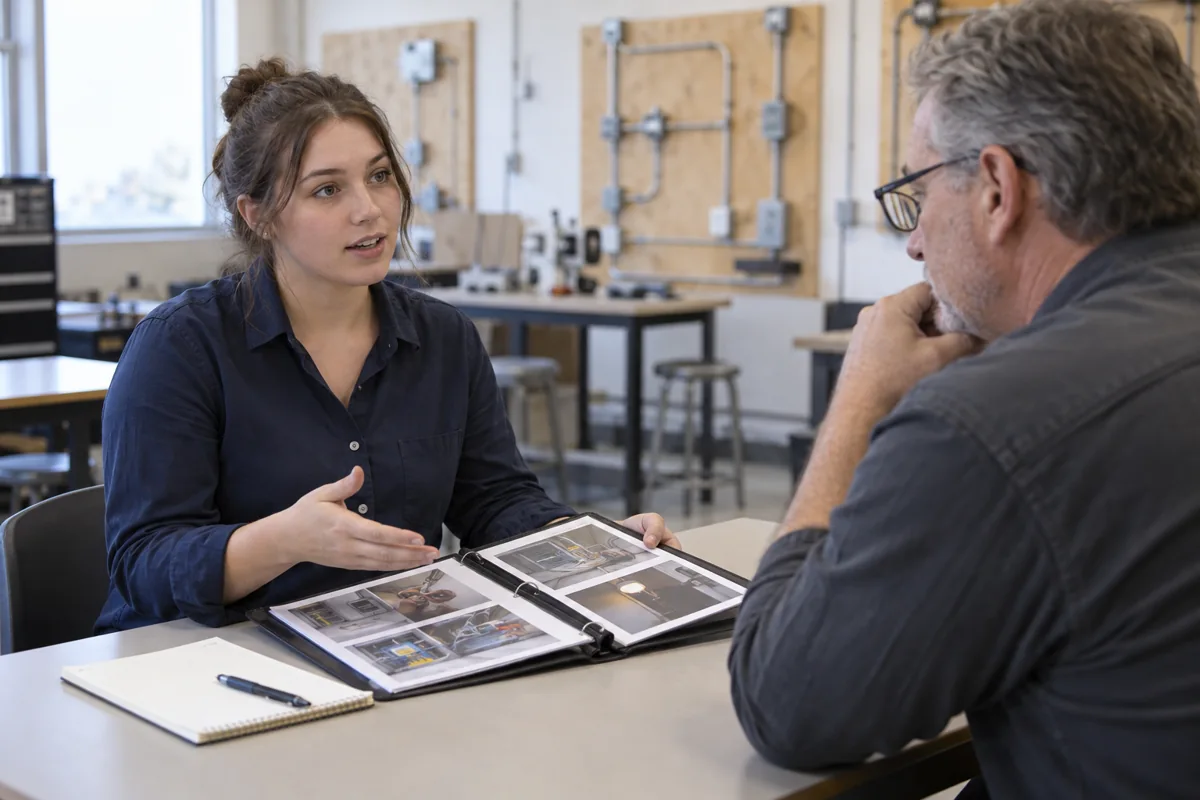
If your sponsor allows a portfolio, keep it short and relevant. A few project photos with captions describing your contribution are easier to discuss than a thick binder with no clear point. Include only credentials you’ve earned and experience you can verify. NIETC specifically allows portfolio materials; another program may have different instructions.
You can draw on an unrelated previous job without renaming it. Our guide to describing restaurant experience on a resume shows how to explain transferable work honestly.
For clothing, follow the invitation. Aim for clean, practical and presentable rather than buying equipment to look like someone who’s already on a jobsite. Confirm which documents or identification the program requests, and plan your route so a wrong entrance doesn’t make you late.
Leave knowing what happens next
If there’s time for questions, ask how applicants receive results and where to find the rules for future consideration. Don’t assume a good conversation means an immediate placement. NIETC, for example, uses a ranked list and takes apprentices as contractor demand permits; that is a local example, not every sponsor’s procedure.
Afterward, write down which answers were clear and which needed a better example. Keep applying through legitimate program and employer channels while following any restrictions your sponsor gives you. The useful goal is an honest interview that makes your preparation visible—not a rehearsed performance that promises experience you don’t have.