
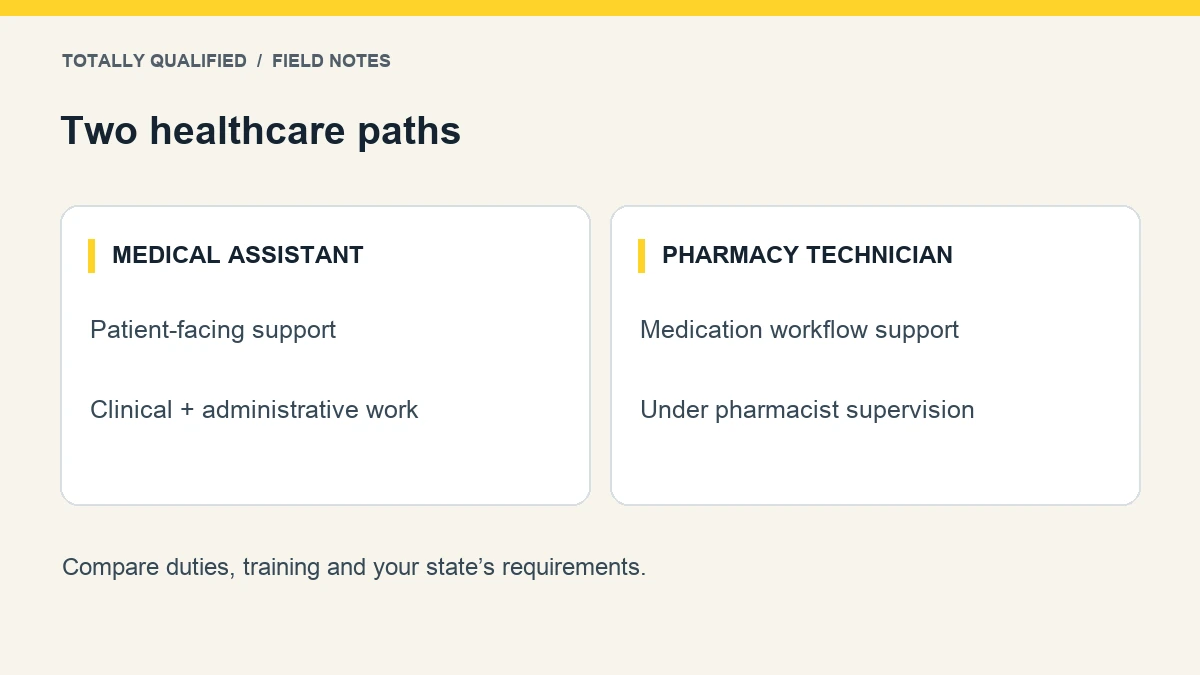
Medical assistant and pharmacy technician pay is close enough that salary alone is a poor way to choose. The better choice depends on the work you want to do, the training you can realistically complete, and the employers hiring near you. Medical assisting may fit someone who wants hands-on patient contact. Pharmacy technology may appeal to someone who prefers the medication workflow and can find a legitimate paid training route.
Neither is an effortless shortcut into healthcare. Both involve accuracy, people who may be worried or frustrated, and knowing when a question belongs with a licensed professional.
Which pays more? The national figures are almost tied
The Bureau of Labor Statistics reports these May 2025 U.S. median annual wages: $45,690 for medical assistants and $45,750 for pharmacy technicians. That is a $60 annual difference between two national estimates—not a meaningful promise that one job will pay you more.
These are occupation-wide medians, not starting offers, take-home pay, or salaries for the same city. Half of workers earn below the median and half above. A beginner shouldn’t budget around either figure before seeing an actual offer.
Use those numbers as a reason to look closer, not as a winner’s podium. A nearby opening with dependable hours and manageable training costs may work better than a higher quoted rate that comes with fewer shifts or a much longer commute.
The everyday difference: the patient visit or the prescription workflow
Medical assistants combine office and clinical support, such as scheduling appointments and taking vital signs. Pharmacy technicians support pharmacists in dispensing medication. The details depend on the workplace, training, and permitted duties; the BLS occupational profiles linked above explain both roles.
Think about what you want your attention to be on. Would you rather help a patient move through a clinic visit, or help keep a pharmacy’s information and prescription process accurate? Neither answer makes you more caring or more capable. They are different preferences.
Also ask what the job actually includes. A medical assistant opening weighted toward front-office work isn’t the same experience as one centered on rooming patients. A pharmacy role in a retail setting shouldn’t be assumed to resemble a hospital position just because the title matches.
A useful interview question for either employer is: “Could you walk me through a typical shift, including the tasks a new hire is allowed to do and who checks the work?” That answer is more informative than a job description that says “fast-paced team environment.”
Compare the route into the job before paying for training
There isn’t one nationwide school requirement that settles this comparison. State rules, an employer’s hiring standards, and a certification organization’s exam requirements are separate checks.
For pharmacy technology, a paid route is a real possibility, not something to assume every employer provides. Walgreens describes a paid technician apprenticeship with training toward certification. That is an example of a route to investigate, not a current job offer or a guarantee that a local store is hiring.
For medical assisting, check the state and the exact role first. California’s Medical Board describes supervised training routes; Washington has specific medical-assistant credentials. A claim that “you never need school” or “everyone needs a degree” misses those distinctions.
Considering the pharmacy route? See how pharmacy technician training without a separate school program works, including state registration, paid training, and PTCB eligibility.
Leaning toward a clinic? Check medical assistant options without a college degree and learn how to compare certificates, apprenticeships, and employer requirements.
Use an offer-to-offer comparison, not a job-title contest
Before choosing a program or accepting a position, write down the same information for each option. Leave an unknown blank rather than filling it with an optimistic guess.
- Base pay: the actual offered rate, separate from a potential raise, bonus, or shift differential.
- Hours: expected weekly hours, whether they are guaranteed, and how often the schedule changes.
- Training: who pays, which hours are paid, what credential results, and whether leaving early creates a repayment obligation.
- Work location: one site or rotating sites, commute, parking, and required travel.
- Benefits: eligibility for your employment classification, waiting periods, and employee costs.
- Support: who trains you, how competency is checked, and what happens if you need more practice.
Here’s an invented example to show why hours matter: $20 an hour for 36 paid hours is $720 gross for that week. $22 for 28 paid hours is $616. Those are arithmetic examples, not typical rates or offers for either profession. They exclude taxes, overtime, benefits, and expenses.
If you’re comparing a flexible opening with a regular schedule, our guide to per diem versus part-time work explains why the employment label deserves a closer look too.
Which path makes more sense for you?
Start with medical assisting if supporting clinic visits is the part of healthcare that interests you and you can identify a training route local employers accept. Don’t commit to a course just because its name contains “medical.” Confirm the credential and practical training it leads to.
Start with pharmacy technology if the pharmacy workflow interests you and there is a lawful trainee route you can afford. A paid apprenticeship is particularly worth investigating if unpaid school time would prevent you from making the transition. Read the conditions rather than treating “paid training” as “no requirements.”
Keep looking at both if your main priority is predictable income. Ask each employer about actual hours, schedule notice, training pay, and benefits before deciding. A national median can’t answer those questions for you.
Your next step doesn’t have to be enrollment. Find two relevant local job descriptions, identify their must-have requirements, and ask the employer or state regulator about anything unclear. Once you know which route is feasible, you can compare openings through employers’ official career pages. This guide is career information, not a vacancy or an application.
Sources checked October 3, 2026. Wage figures cover May 2025, the period identified in the BLS profiles consulted. Requirements vary by state and employer; no salary or hiring outcome is guaranteed.