
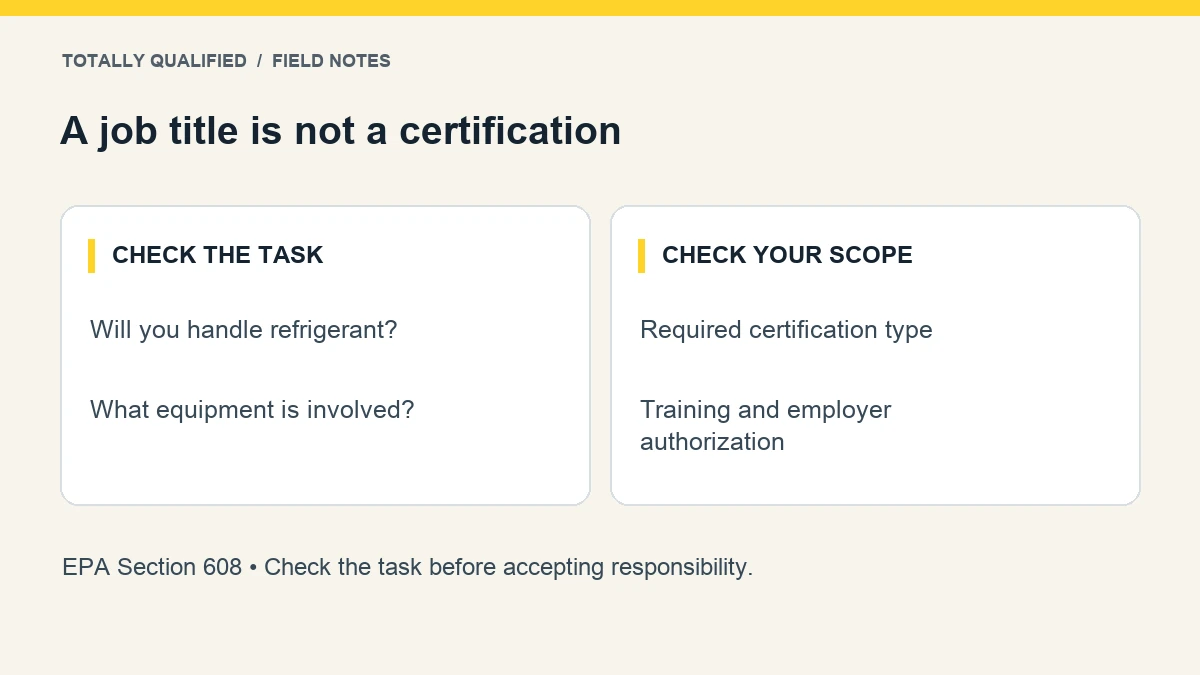
You don’t need EPA Section 608 certification for every apartment maintenance task. You do need the appropriate certification for covered work that could release refrigerant, unless a specific exemption applies. An employer may also require the credential before hiring because it wants someone ready to handle that work.
Those are two different questions: What does federal law require for this task? and What qualifications does this particular job require? Answer both before paying for a course—or telling an interviewer you can service the property’s air-conditioning equipment.
The requirement follows the work, not the job title
The EPA’s Section 608 certification guidance covers technicians who service, maintain, repair, or dispose of equipment in ways that could release refrigerant. Its examples include attaching gauges to measure appliance pressure and adding or removing refrigerant. Painting a vacant unit or cleaning a hallway doesn’t become refrigerant work simply because your badge says “maintenance.”
EPA lists four certification categories: Type I for small appliances; Type II for high- or very-high-pressure appliances, with specified exclusions; Type III for low-pressure appliances; and Universal for all types. The equipment you will service determines which certification is relevant. The EPA also says these credentials don’t expire and describes a closely and continually supervised apprentice exemption. Being new to the job, by itself, isn’t that exemption.
Don’t use this distinction to guess your way into a repair. Have the supervisor identify the equipment, permitted tasks, training, and applicable requirements before assigning independent work. Certification is one part of being ready for the task; it doesn’t establish every practical skill.
What an apartment job ad may mean by “EPA required”
An employer can set qualifications around the work it expects a technician to handle. For example, Windsor Communities’ Dallas dual-site technician description lists EPA Type II as preferred or obtainable within 90 days of starting, alongside maintenance experience. That is one employer’s stated arrangement for a particular role, not a universal deadline or permission to perform regulated work before qualifying.
Read the wording carefully. “Required at hire,” “must obtain after hire,” and “preferred” don’t mean the same thing. If the ad says only “EPA certified,” ask which type. If it names a deadline after starting, ask what work you would do until then and who supervises it.
You may also see combined titles that blur support work and technical repairs. Our comparison of apartment porter and maintenance technician jobs explains how to check the actual responsibilities instead of deciding from the label.
A course, a certification, and a maintenance credential aren’t interchangeable
A training provider can help you prepare, but a course-completion document isn’t automatically the required certification. EPA explains that certification comes from passing an approved test administered through an approved certifying organization. Check the provider and the exam being offered before spending money.
There’s also broader apartment maintenance training. The National Apartment Association’s Certificate for Apartment Maintenance Technicians, or CAMT, has its own experience, coursework, and examination requirements. It develops apartment maintenance knowledge. Don’t list CAMT, EPA 608, and a state trade license as though they’re alternative names for one qualification.
Likewise, an EPA credential doesn’t settle every state or local licensing question or the employer’s safety procedures. Ask what additional qualifications apply to the actual work and location. A hiring ad can summarize expectations; it can’t be your only source for deciding the legal scope of a repair.
Before paying, get these answers
Start with the jobs you can realistically apply for. If several local openings request the same certification, that is more useful than a training advertisement promising a job after a quick class.
- Which equipment and duties would I be assigned? Get more detail than “HVAC as needed.”
- Which certification must I hold on day one? Confirm the type and whether the requirement is mandatory or preferred.
- Does the employer provide or reimburse training and testing? Ask about payment timing, retakes, and any conditions before enrolling.
- How will practical training and supervision work? Passing an exam and being prepared for solo calls are separate milestones.
If you haven’t earned the credential, say so plainly. “Studying for Type II; exam scheduled for [scheduled exam date]” is appropriate only when it’s true. Don’t write “EPA certified” because you’ve purchased a course or watched the lessons.
For a first step, compare the qualifications in current openings through employers’ own career pages. Choose training against a real requirement, and confirm the work you’ll be qualified and authorized to perform when you finish.
Sources checked October 3, 2026. The Windsor posting is a dated employer example, not a guarantee of an open vacancy or a rule applying to every employer.