
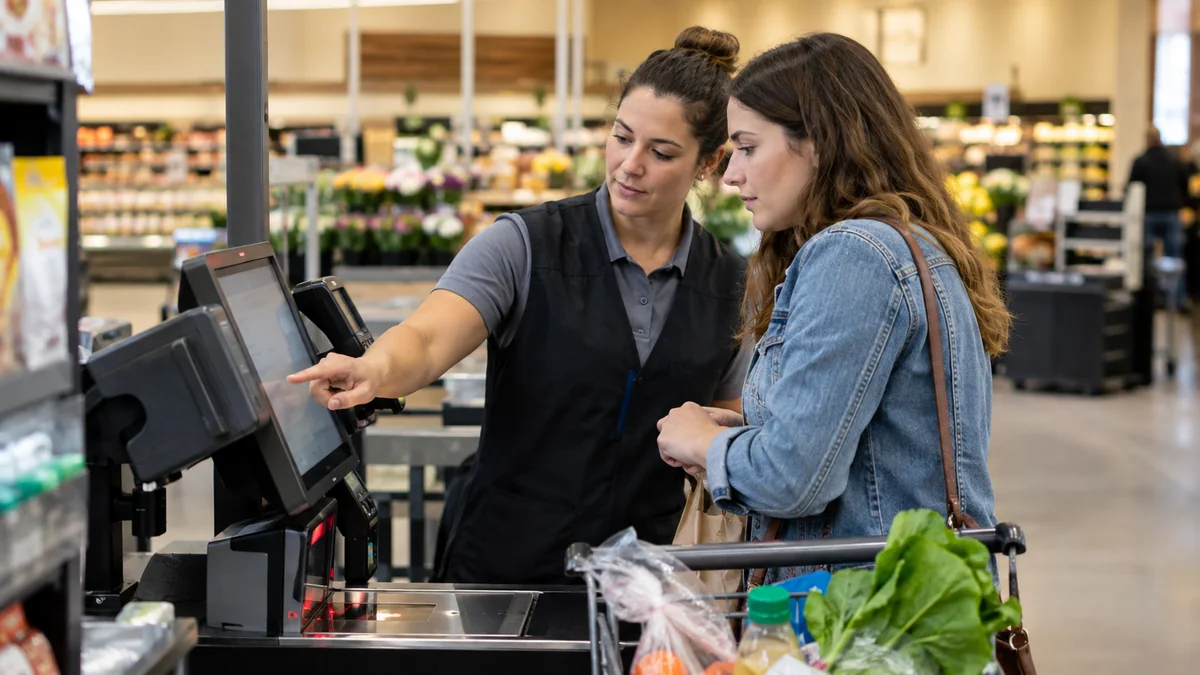
A self-checkout attendant helps customers finish purchases when the checkout needs human help. That can mean finding an item on the screen, checking a price, responding to an approval request, or calling someone with the authority to solve a problem.
The tricky part isn’t learning where one button is. It’s keeping track of several customers without rushing past a payment problem or leaving someone standing there wondering whether you’ve noticed them.
If you’re considering this job, ask what the store means by “self-checkout.” It may be a dedicated assignment, or one part of a cashier or front-end associate position.
What the attendant actually handles
The Bureau of Labor Statistics includes overseeing self-checkout stands among cashier duties. Its broader cashier profile also covers payments, customer questions, returns, and keeping a checkout area orderly. A particular store may divide those responsibilities among different people.
Here’s how the self-checkout portion can play out. These are examples of situations to prepare for, not a substitute for an employer’s operating procedures.
- A shopper can’t find produce on the screen. You help them find the appropriate item rather than guessing a similar, cheaper product.
- A price doesn’t look right. You check the item and the store’s process for a price inquiry. Being helpful doesn’t necessarily give you permission to override a price.
- A terminal requests an approval. You determine what it needs and whether you’re authorized to handle it. Some interventions belong to a supervisor.
- A customer isn’t sure a payment went through. You follow the store’s transaction-checking process. Don’t casually tell someone to pay again or promise that a charge has been reversed.
- Several people need help. You acknowledge them, address immediate safety issues, and request backup when necessary.
The last point matters. A short “I see your light; I’ll be with you next” can be more useful than silently walking between machines while everyone tries to make eye contact.
Self-checkout attendant versus cashier
At a staffed register, the cashier generally moves through one customer’s transaction at a time. At self-checkout, the customer does much of the scanning, while the attendant moves between exceptions and questions. That changes how you divide your attention.
It doesn’t mean you can ignore accuracy. The O*NET cashier profile identifies checking prices, answering policy questions, requesting assistance, and maintaining checkout areas as parts of cashier work. Those are useful skills to discuss when applying for a front-end position, even if the advertisement uses a different title.
Read the entire posting. “Checkout associate,” “front-end associate,” or “cashier” may include self-checkout coverage without putting it in the title. Conversely, a role labeled self-checkout may still rotate you onto a regular register.
The boundaries are part of the job
Being the nearest employee doesn’t make you the manager, a repair technician, or loss prevention.
Before working independently, find out which approvals your access allows, what to do with a failed terminal, how to request help, and what the store expects if you suspect an item wasn’t scanned. Don’t invent your own confrontation policy. Follow the employer’s safety and escalation instructions.
For age-restricted purchases, learn the applicable rules and the store’s approved verification procedure. The requirement may depend on the product, location, and your assignment. “The customer looks old enough” isn’t a training plan.
A useful question during training is: “What should I do when I can’t resolve this myself?” Ask for the next step, the person to contact, and what to tell the waiting customer.
Can you get hired without experience?
It can be an entry-level job, but the posting decides the requirements. BLS says cashier positions typically have no formal education requirement and use on-the-job training; some employers prefer a high school diploma. That describes the occupation, not a promise that every store will hire every first-time applicant.
You don’t need to pretend you’ve used a checkout system you haven’t touched. Give an honest example of learning a process, handling a busy situation, or noticing a mistake and fixing it. School projects, volunteering, and other work can provide examples if they’re real.
Also be specific about when you can work. “Anytime” can turn into a problem if you actually have classes three evenings a week. Our guide to writing your availability on a job application helps you state a schedule you can keep.
Preparing for an interview? These grocery cashier practice questions for first-time applicants cover price checks, busy lines, and how to discuss a mistake honestly.
Questions worth asking before you accept
Instead of only asking whether the job is easy, ask what a busy shift looks like:
- Will I cover self-checkout exclusively or rotate through other front-end duties?
- How many stations would I normally cover, and who provides backup?
- How long is supervised training, and who signs off before I work alone?
- What are the actual shift times, expected weekly hours, and weekend requirements?
- Who handles refunds, payment disputes, equipment trouble, and safety concerns?
The answers help you distinguish a well-supported first job from a position where “training” means being handed a login and pointed toward a blinking light.
Self-checkout work suits someone who can stay observant, explain a next step without making customers feel foolish, and ask for help before a small issue grows. It can also be tiring: you’re dealing with people, interruptions, and time on your feet. Choose it for the actual work, not the assumption that the machines do everything.
When you’re ready to compare openings, check employers’ own career pages. Confirm the location, schedule, and duties in each current listing.