
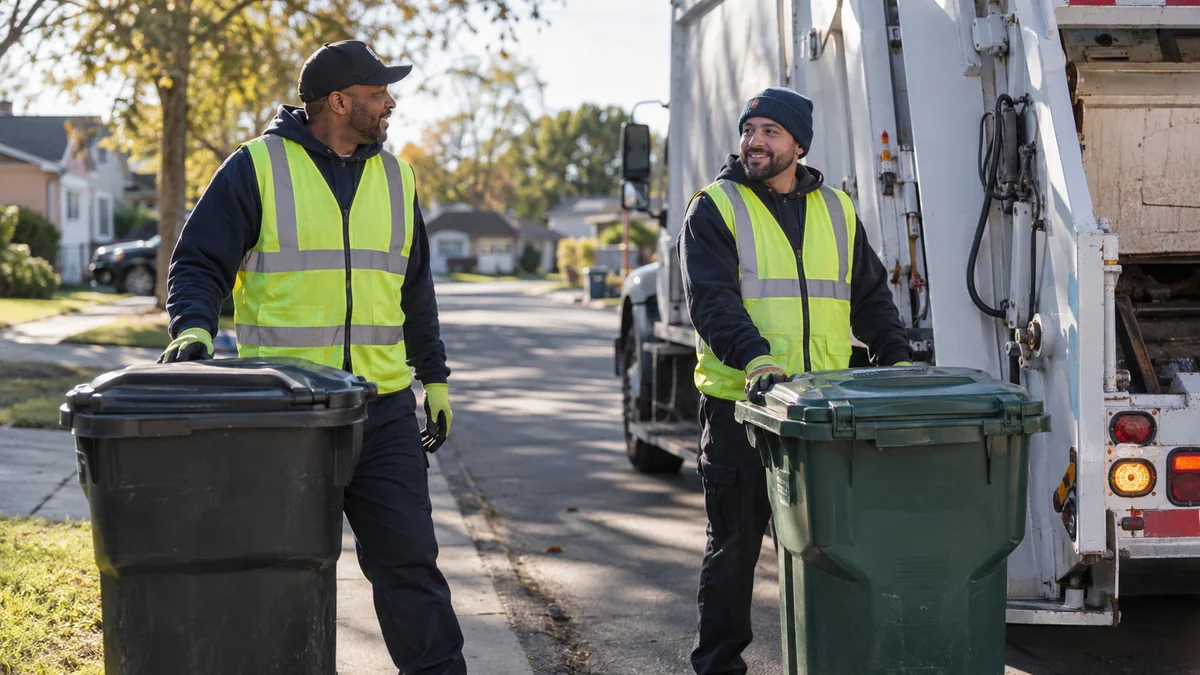
Some garbage collectors earn more than office workers because the job can combine solid hourly pay, negotiated wage steps, commercial-driving skills and paid overtime. Location matters, too. A long-serving municipal sanitation worker in a high-cost city isn’t on the same pay scale as a new collection helper. Benefits can strengthen the offer, but a pension contribution isn’t cash in your paycheck.
The surprising part: you don’t need an extraordinary overtime story to support the comparison. National wage data already put refuse collectors ahead of general office clerks. That doesn’t make garbage collection easy money—or mean it beats every office career.
How much do garbage collectors make?
The Bureau of Labor Statistics’ May 2025 wage release reports a mean of $25.39 an hour, or $52,820 a year, for refuse and recyclable material collectors. The median hourly wage was $23.89: half earned less and half earned more.
Here’s a comparison from that same release, using national means throughout:
| Occupation | Mean hourly wage | Mean annual wage |
|---|---|---|
| Refuse and recyclable material collectors | $25.39 | $52,820 |
| General office clerks | $22.32 | $46,420 |
| Receptionists and information clerks | $18.97 | $39,460 |
| Executive secretaries and executive administrative assistants | $38.05 | $79,140 |
These are occupational estimates, not starting offers. BLS annualizes hourly means using 2,080 hours. The executive-assistant row is an important reality check: “office worker” covers very different jobs. A fair comparison needs an actual occupation, location and experience level.
Also, this BLS wage measure excludes overtime, shift differentials and employer benefit costs. Don’t compare it with somebody’s overtime-heavy earnings or a city’s total-compensation figure and call the difference a base-pay advantage.
Why some sanitation jobs pay more
A collection route requires more than lifting bags. Driving a heavy truck safely through residential streets, operating its equipment and working around traffic carry responsibility. Some jobs require a CDL before you start; others offer a route to obtaining one.
Pay can also rise through a published progression rather than a new negotiation every year. New York City’s agreement with Uniformed Sanitationmen’s Association Local 831 documents collective bargaining over compensation. That is a concrete union example, not proof that every sanitation employer has the same terms.
Then there’s the schedule. A route still needs completing when the weather is miserable or a holiday disrupts collections. The Los Angeles recruitment bulletin discussed below explicitly lists possible weekend, holiday and overtime work. Extra earnings can mean extra hours away from home, not a higher reward for the same workweek.
Don’t assume a national worker shortage explains every attractive salary. These sources establish pay and hiring requirements; they don’t establish a universal sanitation labor shortage. A vacancy, by itself, isn’t evidence of one.
Base pay versus overtime: do the hours first
Consider a hypothetical worker earning $25 an hour. Forty hours produces $1,000 before deductions. Five additional hours paid at time-and-a-half add $187.50. If that exact pattern continued for 52 weeks, gross earnings would be $61,750 instead of $52,000.
That’s a meaningful difference—but it requires 260 extra working hours. It isn’t a salary promise, and it doesn’t include taxes, unpaid time or benefits. Overtime might be seasonal, assigned by seniority, mandatory or unavailable when budgets change.
The Department of Labor’s general rule requires covered, nonexempt workers to receive at least time-and-a-half after 40 hours in a workweek. Exceptions and public-sector arrangements can matter. Ask the employer how the particular position handles overtime, including whether eligible extra hours are paid in cash or compensated through an applicable time-off arrangement.
Before accepting an offer, ask: “What is the guaranteed base rate, how much overtime did this position actually receive recently, and can I decline extra shifts?” Build your essential monthly budget around dependable pay.
Three local examples—and what the numbers actually mean
New York City: the DSNY salary page checked September 17, 2026 lists $47,752 starting pay and progression to $95,316 after 5½ years. It separately mentions assignment differentials and overtime. Those are the figures displayed on that page, not a verified offer for a particular appointment date; confirm the applicable contract step with DSNY. The upper figure is plainly not new-hire pay.
Los Angeles: an August 2025 city recruitment bulletin listed two annual ranges for refuse collection truck operators: $70,637–$87,779 and $78,007–$96,924. It said appointments normally go into the lower pay grade and required qualifying truck experience plus a California Class B license. This closed bulletin is a documented pay example, not a current opening or a guarantee of today’s rates.
Asheville, North Carolina: a July 2026 Sanitation Driver I posting advertised $22.80 an hour. At 2,080 hours, that would be approximately $47,424 before overtime—our calculation, not an annual figure promised in the posting. It required a CDL permit and the ability to obtain a full Class B within 90 days. That application window has also closed.
These examples show variation, not a ranking of America’s highest-paying cities. Rent, commuting costs, starting grade and years needed to reach the top rate can change which offer is better for you.
Municipal versus private collection jobs
Check who actually employs the crew. A truck collecting residential trash doesn’t necessarily belong to the city; the work may be contracted out. Municipal and private openings need separate applications, and their pay structures aren’t interchangeable.
A city listing may spell out classifications, examination requirements and salary steps. A private offer may use a different progression or retirement arrangement. Neither label guarantees better compensation. Compare the documents, not the logo on the truck.
Request the hourly rate, normal weekly hours, overtime rules, insurance premiums, retirement contributions, paid leave and probation terms. Ask whether the advertised figure includes incentives that you might not earn. Also ask what a normal route looks like: the number of stops, manual loading, equipment used and expected finishing time.
Benefits matter, but read the conditions
DSNY lists health benefits, a pension and deferred compensation. These can make a municipal offer attractive beyond its headline salary. They aren’t universal sanitation benefits, and retirement eligibility depends on the applicable plan and service rules.
Separate three questions: What money will reach your paycheck? What costs will the employer cover? What benefit becomes yours only after you meet a future requirement? That prevents counting a retirement promise as money available for this month’s rent.
Compare waiting periods and employee contributions, too. A health plan with a substantial payroll deduction feels different from an otherwise similar plan with a lower deduction. If you expect to change careers soon, check vesting before assigning a large personal value to a long-service pension.
Do you need a CDL to collect garbage?
For many truck-driving roles, yes. For every helper or collection role, no. The vehicle and assignment decide the licensing requirement. FMCSA’s Class B definition generally covers a single vehicle with rated or actual gross weight of at least 26,001 pounds, using the greater figure, with separate rules for towing and special operations.
The Asheville example allowed a permit-to-license progression; Los Angeles required the Class B license at application. NYC’s sanitation hiring requirements include a high school diploma or GED and the appropriate New York Class A or B CDL by appointment, along with physical, medical and other checks. NYC hires from a civil-service list after an exam; it isn’t simply a walk-in application.
If you’re comparing driving careers, our guide to CDL requirements for box trucks explains why vehicle weight matters more than a casual job label. Ask about employer-supported training before paying for a course yourself.
Is it a good career for you?
It can be a practical path for someone who wants hands-on work and a documented pay progression. It can also be physically punishing. BLS identifies refuse collectors among occupations with high injury and illness rates. Weather exposure, early starts and repeated physical work deserve as much attention as the pay scale.
Ask how new workers learn the route, how the employer handles heat and unsafe conditions, and what equipment reduces lifting. A worthwhile job shouldn’t require treating preventable injuries as proof of toughness.
How to find sanitation jobs near you
Search official city and county career sites for “sanitation worker,” “solid waste operator,” “refuse collector” and “refuse collection truck operator.” For private employers, use the company’s own careers page. Verify application dates: old government bulletins often remain searchable long after closing.
Read the minimum qualifications before buying training. If you’re in New York City and need help planning your search, Workforce1 offers free career support; that support doesn’t replace DSNY’s separate civil-service process. We aren’t advertising a sanitation vacancy here.
Frequently asked questions
Can garbage collectors make $100,000?
Some workers may reach six figures through an applicable local pay scale, seniority and extra paid work. That isn’t the typical national wage or a starting-pay promise. Ask whether a quoted number is base salary, annual earnings including overtime, or compensation including benefits.
Do you need a college degree?
A four-year degree isn’t a universal requirement. NYC’s cited entry requirements specify a high school diploma or GED, while driving credentials and other checks also apply. Read the actual posting; “no degree required” doesn’t mean “no qualifications required.”
Does garbage collection pay better than office work?
It pays more than some office occupations in the national comparison above, and less than others. Compare offers at the same experience level, then divide earnings by the hours needed to earn them. The better offer is the one whose pay, demands and progression work for your life.