
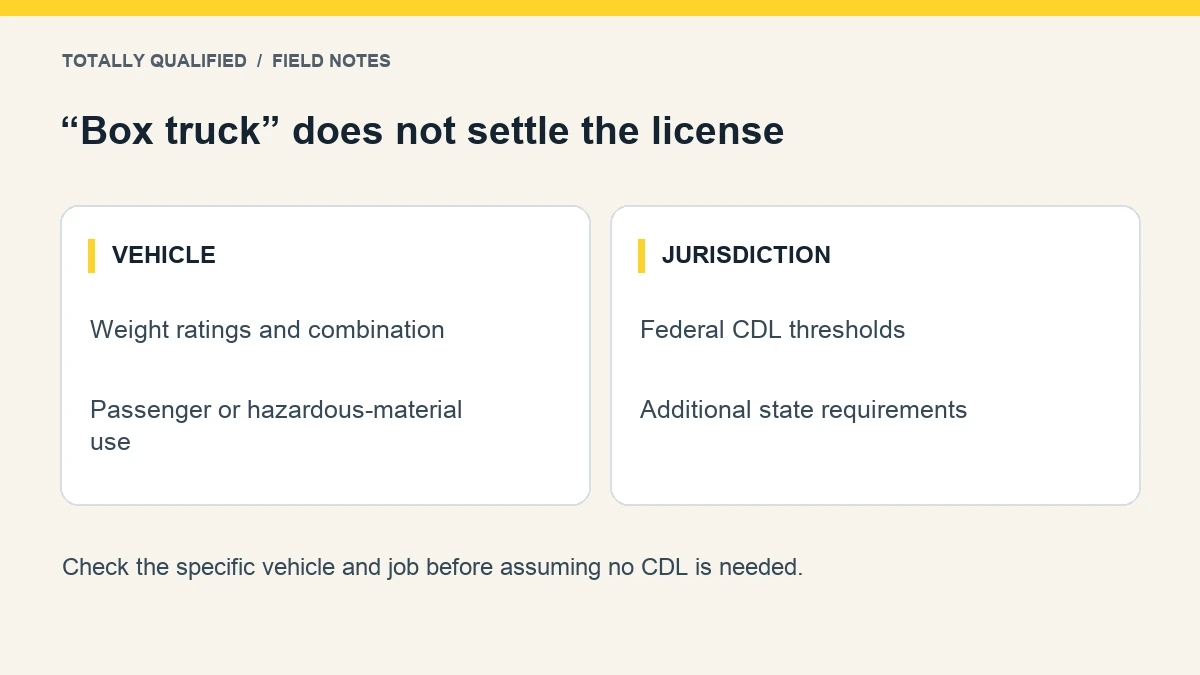
Not every box-truck job requires a CDL. For ordinary freight in a single truck, the federal Class B threshold is 26,001 pounds, using the vehicle’s rated or actual gross weight, whichever is greater. Below that threshold, you still need to check the cargo, any trailer, state licensing rules and the employer’s requirements. “Non-CDL” doesn’t mean “no other qualifications.”
The length of the box won’t settle it. Two trucks advertised as 26-foot models can have different licensing requirements. If you’re considering a delivery job, ask about the exact vehicle before paying for training or assuming your current license is enough.
This guide covers U.S. commercial driving jobs. Personal household moves, farm operations and other exemptions need a separate review; don’t apply a rental-for-your-own-move answer automatically to paid delivery work.
Start with the truck, not the job title
GVWR means gross vehicle weight rating: the manufacturer’s rating for the loaded vehicle. GVW is the truck’s actual gross weight. Neither is the same as cargo weight alone.
The FMCSA’s CDL classifications use both ratings and actual weights. An empty truck rated at 33,000 pounds doesn’t become a non-CDL truck because it currently weighs much less. In the other direction, a low rating doesn’t make an overloaded truck legal or erase the actual-weight test.
Ask the employer to identify the assigned truck and show you its GVWR documentation. Don’t substitute an internet specification for a similar model, the truck’s empty weight or a guess about what the boxes weigh. If a trailer is involved, the combination needs its own classification check.
These are hypothetical commercial-driving examples, not clearance to drive a particular vehicle:
- Single truck rated at 26,000 pounds, with actual weight below that: it doesn’t meet the federal Class B weight threshold. Cargo, state and other requirements still matter.
- Single truck rated at 33,000 pounds, currently empty: the rating puts it in CDL territory even without a delivery load.
- A box truck pulling a trailer: don’t use the single-truck answer. Both the combination and the towed unit matter.
For a real fleet example, Penske lists both CDL and non-CDL medium-duty trucks in the same 22- and 26-foot sizes. Its distinction is the vehicle’s weight rating. That illustrates why length is a poor shortcut; it isn’t an endorsement of a rental company or a statement that every truck in a size category is identical.
When a trailer or special cargo changes the answer
Under FMCSA’s Class A definition, the combination reaches 26,001 pounds or more, using the greater of its gross combination rating or actual weight, and the towed unit or units exceed 10,000 pounds using the greater of their rating or actual weight. A trailer over 10,000 pounds by itself isn’t the complete test.
A heavy single truck towing a vehicle that doesn’t exceed the 10,000-pound limit falls under the Class B description instead. If a job changes from a straight truck to a truck-and-trailer assignment, have the employer’s safety staff verify the combination and your license before the assignment.
Weight isn’t the only trigger. A smaller vehicle carrying hazardous materials that require placards can require a Class C CDL and the appropriate endorsement. FMCSA’s definition also covers certain select agents or toxins. Passenger-carrying vehicles have a separate threshold, although that isn’t the ordinary box-truck delivery job discussed here.
Don’t decide whether cargo needs placards by looking at a package or relying on the phrase “just supplies.” Ask the carrier to confirm the cargo classification and required credentials.
A non-CDL job may still require a DOT medical certificate
This is a different question from the CDL weight threshold. FMCSA’s medical guidance explains that commercial drivers operating qualifying vehicles over 10,000 pounds in interstate commerce generally need a valid Medical Examiner’s Certificate, subject to applicable exceptions. That can include a driver who doesn’t need a CDL.
FMCSA also has a broader set of motor-carrier safety requirements. A non-CDL label doesn’t, by itself, excuse an operation from driver qualification, inspection or hours-of-service rules. Which requirements and exceptions apply depends on the operation.
Ask whether the role is treated as interstate or intrastate and what medical documentation is required. Don’t infer the answer just from “local delivery” in an advertisement. Get the requirement from the carrier’s safety or hiring team, then check the relevant state agency if something is unclear.
Check your state’s license requirements too
“No CDL” and “an ordinary car license is sufficient” aren’t interchangeable statements in every state.
For example, Michigan’s chauffeur-license guidance says that, unless exempt, people employed principally to operate a vehicle rated at 10,000 pounds or more need a chauffeur’s license. It also describes requirements for common or contract carriers of property. A driver can therefore need a state credential even when the federal CDL weight threshold isn’t met.
That’s a Michigan example, not a national chauffeur-license rule. Check the licensing agency for the state issuing your license and any requirements applicable to the operation. Give it the truck and trailer ratings, the work being performed and the cargo, rather than asking only whether a “box truck” needs a special license.
What to ask before accepting a delivery job
Send the hiring contact a short, specific request:
Which truck would I drive, and what are its GVWR and any trailer requirements? Which license class, endorsements and medical certificate does this assignment require? What training do you provide before a new driver goes out alone?
Then ask about the work itself: loading and unloading, liftgate use, stairs, delivery windows and whether the employer provides a helper. A non-CDL driving role can still involve equipment and tasks you haven’t done before.
Keep truck licensing separate from warehouse equipment training. If the role also involves a forklift, our guide to forklift certification before applying explains why a course certificate isn’t a substitute for the employer’s required training and evaluation process.
Considering a different kind of local driving? Our garbage collector salary guide compares sanitation pay, overtime and municipal hiring requirements, including examples of Class B truck roles.
Once the vehicle and credentials are clear, compare actual openings through employer career pages. Search terms such as “non-CDL delivery driver” help locate possibilities, but the assignment details—not the search filter—tell you what you’re qualified to drive.