
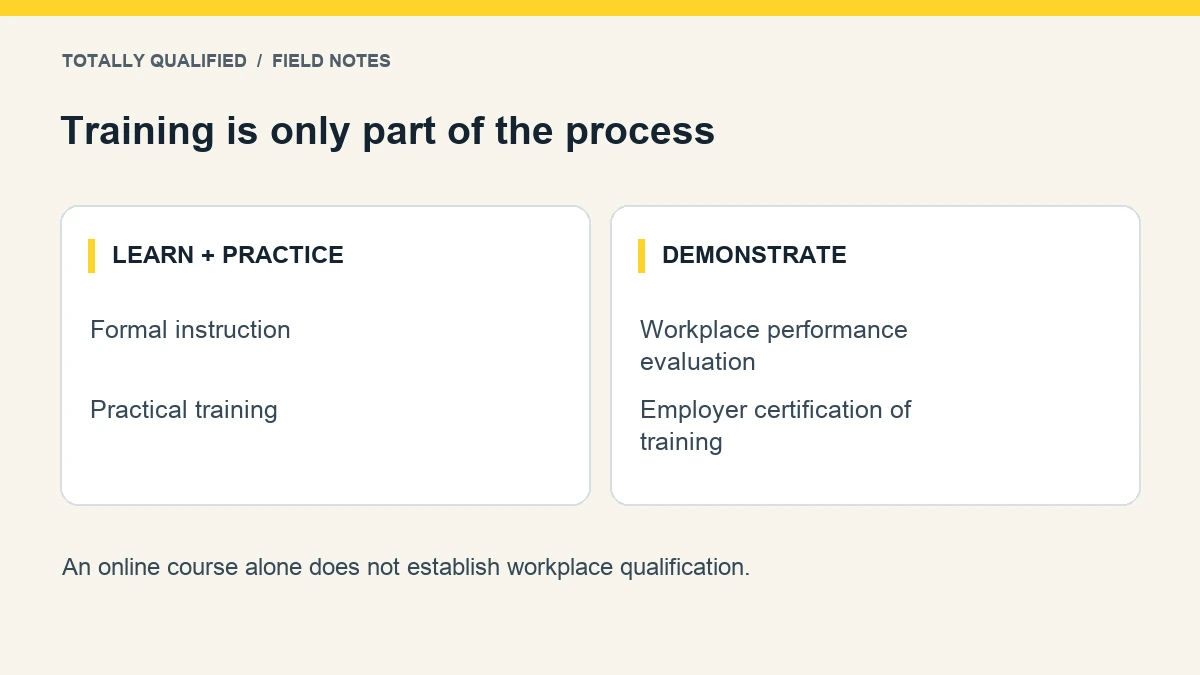
You don’t need to buy a forklift certificate simply to apply for a job. Some employers want experienced operators; others offer training. Read that distinction before spending money. Completing an online course alone doesn’t qualify you to operate a forklift at work.
The confusing part is the word “certified.” A course provider may mean you passed its online test. An employer needs to know whether you’ve had the relevant instruction, practical training and evaluation. Those aren’t interchangeable claims.
This guide is for U.S. job seekers considering warehouse and similar general-industry positions. It explains what to ask before applying or paying for a course—not how to operate the equipment.
Applying for the job and operating the truck are different steps
Under OSHA’s powered industrial truck standard, section 1910.178(l), employers must ensure operators are competent before permitting them to operate, except under the standard’s supervised-training conditions. Training combines formal instruction, practical exercises and a workplace performance evaluation. The employer certifies completion.
That doesn’t turn a privately purchased card into a universal prerequisite for submitting an application. The hiring requirements still belong to the specific opening.
If an ad says “training provided,” ask whether it includes beginners who’ve never operated a truck. If it requires two years of reach-truck experience, a short introductory course won’t give you those two years. Look for a trainee position instead of changing your application to match a requirement you haven’t met.
For a broader starting point, our guide to a first warehouse job with no experience explains picking, packing and other roles. You don’t have to begin with an equipment-operator vacancy to investigate warehouse work.
What an online course can—and can’t—cover
Online learning can be part of the formal instruction OSHA allows. It doesn’t supply the practical exercises or workplace evaluation just because a downloadable card appears after the quiz. A package might arrange those additional parts separately; find out exactly what’s included.
Before buying, send the provider these questions:
- Does the price cover online instruction only, or supervised hands-on training too?
- Which truck types will I actually train on?
- Where does the practical portion happen, and who evaluates me?
- What records will I receive showing the training and evaluation completed?
- What must a future employer still check or provide?
Ask for written answers. “Accepted everywhere” doesn’t explain how a course addresses the equipment and conditions at a workplace the provider hasn’t seen. Don’t confuse a training company’s website with the federal agency: OSHA’s official domain is osha.gov.
A useful class can still be an incomplete route to the job you want. For example, if you’re considering a course covering a sit-down truck but the local ads ask for another type, ask prospective employers whether that course would be relevant before enrolling. Don’t assume every machine called a forklift involves the same preparation.
Previous training isn’t worthless, but a card isn’t automatic permission
You may have records from an earlier employer or a third-party training organization. Bring them. OSHA’s compliance guidance on third-party training allows employers to rely on qualifying outside training and evaluation under specified conditions. It also explains when additional workplace-related instruction is needed.
The practical question is what your records establish for this job. Ask the employer which equipment and training details it needs to review and what remains before you can operate there. Avoid either extreme: “My old card lets me drive anything” or “Everything I’ve learned becomes invalid when I change jobs.”
Keep the course outline, dates, evaluation details and equipment information together if you have them. A photo of the front of a wallet card may not answer the employer’s questions. If the records are incomplete, describe the gap honestly rather than guessing what your previous training covered.
Should you pay before you have an offer?
Our recommendation: talk to employers before choosing a course. Save a few reachable openings and separate those offering training from those requiring operating experience. Contact the employer or recruiter through a verified business channel.
“I’m applying as a beginner and haven’t operated a forklift. Does this opening include hands-on training and evaluation, or do you require prior operating experience? If outside training is useful, what would you want it to cover?”
That answer gives you a better purchasing decision than a course advertisement promising to improve your resume. An employer may train selected applicants, prefer a particular program or need someone already experienced. None of those answers guarantees an offer.
If you want help finding local options, CareerOneStop’s training resources provide program-search and funding tools. Its guide to paying for short-term training explains that assistance depends on eligibility and program rules. Check before enrolling; don’t assume a course will be reimbursed.
Compare the full cost, including travel to practical sessions and any separate evaluation fee. Also check the cancellation terms. An inexpensive online component isn’t necessarily an inexpensive complete program.
How to describe your training honestly
If you’ve completed only the online portion, say that. For example: “Completed online forklift safety instruction through [provider], [month/year]; practical training and workplace evaluation not yet completed.” Replace the placeholders and use the statement only if accurate.
If you have operating experience, identify the truck type and work you actually performed, along with available training records. Don’t write “OSHA licensed” merely because a course used OSHA standards in its materials.
When an application offers only a yes/no “certified” question and your situation doesn’t fit, ask the recruiter what documentation the employer means. Don’t choose yes on the assumption that you can sort out missing training later.
Before the first shift, settle who provides the remaining training
Temporary workers need clarity too. OSHA’s powered industrial truck training bulletin for staffing agencies and host employers addresses their respective roles. Ask both contacts who handles site-specific instruction and evaluation; don’t let each assume the other has finished it. The bulletin also notes the federal prohibition on forklift operation by workers under 18.
An old date on a card isn’t the only reason further evaluation or training may be needed. OSHA requires performance evaluation at least every three years, with refresher training triggered by circumstances such as unsafe operation, an incident, different equipment or relevant workplace changes. Don’t treat a three-year interval as permission to ignore an immediate training need.
For your job search, the next step is small: identify an opening that fits your actual experience, then ask what training it provides. Check employers’ own career pages for current openings. Get the answer before buying a certificate—and get the required training before operating the equipment.